

Bernardo Faria spent over a decade collecting titles on the biggest mats in the world, the kind of career that comes with two or three training sessions a day and a plate that matches that workload. Then in 2017 he stepped away from competition, and the discipline he built during his competing years quickly turned into a problem he didn’t see coming.
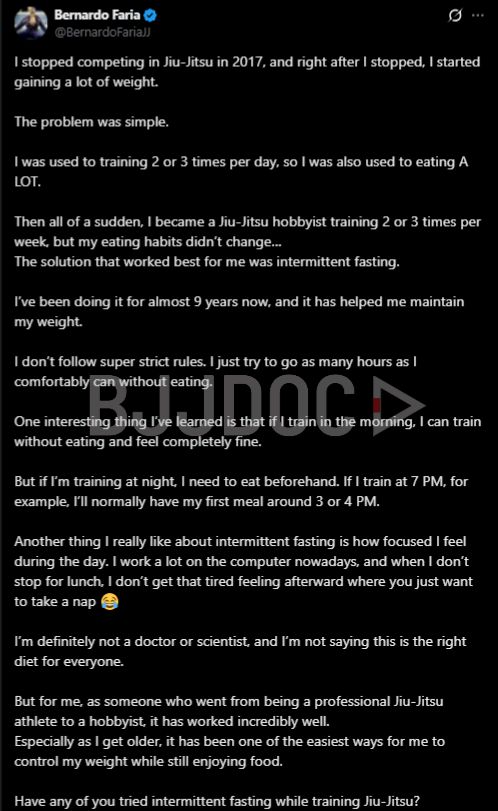
“I stopped competing in Jiu-Jitsu in 2017, and right after I stopped, I started gaining a lot of weight,” Faria wrote, describing the shift that followed his retirement from the competitive circuit.
The math behind it was simple, but it caught up with him fast. “I was used to training 2 or 3 times per day, so I was also used to eating A LOT,” he explained.
Once the training volume dropped to a few sessions a week, the appetite habits built over years of high output didn’t adjust with it, and the extra calories started showing up on the scale.
Faria tried to find a way to bring things back into balance without giving up the food he enjoyed, and he landed on a method that has become a fixture of his routine ever since.
“The solution that worked best for me was intermittent fasting,” he said. Nearly nine years later, it’s still the approach he leans on. “I’ve been doing it for almost 9 years now, and it has helped me maintain my weight.”
What makes his version notable is how loose it actually is. Faria isn’t counting down to the minute or following a rigid protocol pulled from a book.
“I don’t follow super strict rules. I just try to go as many hours as I comfortably can without eating,” he said.
He’s also learned that the plan bends around his schedule rather than the other way around. On mornings when he’s rolling, food isn’t a requirement.
“If I train in the morning, I can train without eating and feel completely fine,” he said. Night sessions are a different story, and he’s built a workaround for those too. “If I’m training at night, I need to eat beforehand. If I train at 7 PM, for example, I’ll normally have my first meal around 3 or 4 PM.”
Beyond the number on the scale, Faria points to a mental clarity that’s kept him sold on the habit, especially now that his days involve a lot more screen time than mat time.
“Another thing I really like about intermittent fasting is how focused I feel during the day. I work a lot on the computer nowadays, and when I don’t stop for lunch, I don’t get that tired feeling afterward where you just want to take a nap.”
Still, Faria is careful not to present his experience as a blanket prescription.
“I’m definitely not a doctor or scientist, and I’m not saying this is the right diet for everyone,” he said.
What he will say is that it fit his specific transition, from a guy whose body was calibrated for professional training loads to someone training as a hobby.
“As someone who went from being a professional Jiu-Jitsu athlete to a hobbyist, it has worked incredibly well,” he said, adding that the benefit has only grown clearer with time. “Especially as I get older, it has been one of the easiest ways for me to control my weight while still enjoying food.”
Faria isn’t the only well known name in grappling to credit fasting for a body transformation. Black belt Tom DeBlass previously went public with his own results after about six weeks on a similar eating window, describing a leaner physique while insisting he hadn’t lost strength in the process.
Both accounts fit into a much larger conversation that has been building around fasting for years. The 16:8 style approach, where eating is confined to an eight hour window, moved from a research concept researchers called time-restricted eating into a mainstream habit largely because of the athletes and media personalities who talked about it publicly.
Podcast host Joe Rogan has described how the practice cut out his midday energy slumps and helped him build lean muscle while eating a high-protein, low-carb diet. UFC standouts Georges St-Pierre and Dana White have made similar claims, with St-Pierre pointing to it as a tool for weight control and career longevity, and White describing it as part of a broader health turnaround.
Short-term trials linked time-restricted eating to reduced inflammation, better blood sugar regulation and weight loss. The catch is that most of those trials ran for less than a year, leaving a gap in understanding what happens to the body over a much longer stretch of time.
That’s the gap a newer study set out to address. Published in Diabetes & Metabolic Syndrome: Clinical Research & Reviews, the research drew on data from close to 20,000 American adults tracked through the National Health and Nutrition Examination Survey between 2003 and 2018.
It found that people who limited their eating to fewer than eight hours a day carried a 135% higher risk of cardiovascular mortality compared with those who spread meals across a 12 to 14 hour window. The pattern held steady across different income levels, racial groups and lifestyle categories, and it survived a range of sensitivity checks the researchers ran to test how solid the finding was. Notably, the increased risk didn’t extend to overall mortality or cancer mortality specifically, pointing to the cardiovascular system as the area of concern.
The researchers behind the study aren’t claiming certainty about why the association exists, but they’ve floated a few possibilities. A tightly compressed eating window might interfere with the body’s circadian rhythm, raise stress hormone levels or push people toward eating large amounts in a short span rather than spacing meals out naturally. There’s also the matter of food quality.
An eight hour window doesn’t guarantee a nutrient-dense diet, and filling it with processed, low-quality food could work against any benefit the fasting itself might offer. Some researchers also point to the rigidity of the approach itself, suggesting that strict adherence to a fasting schedule can push people to extremes that aren’t necessarily sustainable or healthy over the long run.
