
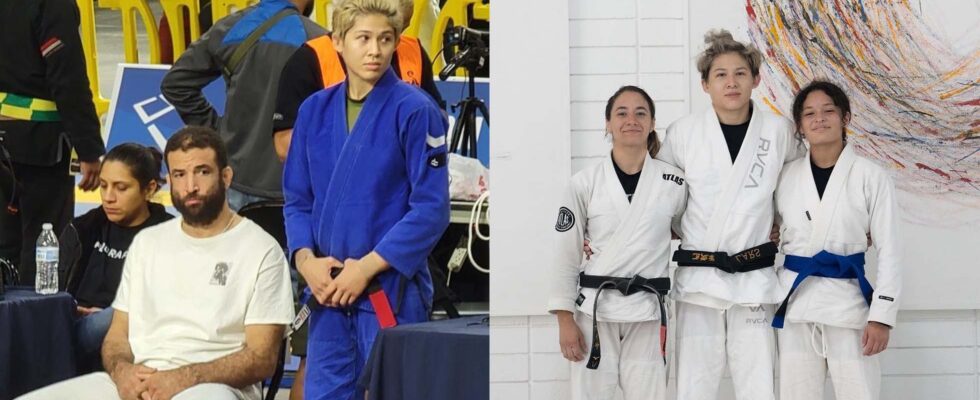
In a recent interview on Grapple Asia, black belt competitor Margot Ciccarelli shared insights into how training at Art of Jiu Jitsu (AOJ) has transformed her game through their unique focus on 3-minute training rounds.
Ciccarelli switched from Unity to AOJ:
“I’m gonna go to Orange County. There are very few distractions. It’s not a very interesting place to be—really f—ing boring, oh my god.”
“Some people may disagree with me, but I’m obviously just giving you my perspective. You will do a lot of Jiu-Jitsu there, but not much else to do. Not much else for you to do unless you’re going to L.A.”
“So yeah, I’ve been putting my head down. I feel like from January to June, I’ve had more growth in six months than the last five years.”
“And that really says a lot, you know? I think, you know, my perception is one thing, but I have had multiple people talking to me after each major tournament that I did this year—which, of course, included the Pan Americans and Worlds—and they’re like, ‘Marg, you look like a completely different person in each competition.'”
“And, you know, technically speaking, I don’t think it changed me that much. Psychology-wise? He completely—he completely broke my psychology.”
“I would say it’s just like—the lifestyle change was entirely different from New York, where our first class of the day was really at 11:30 for most of us. And AOJ is starting at 6.”
“So I’m waking up daily between 4:45 a.m. to 5:00 a.m., and my first class is at 6. And that took me a couple of months really to get adjusted. Not to mention, it’s not just about the adjustment period—it’s like, well, can I perform well at that hour when everyone else at the academy, who has been there for years, is so in tune with that routine?”
“So I felt like at the beginning, man, I had turned into a purple belt. I was like—I dropped two belt grades when I stepped into AOJ.”
“I had to really try and understand: what is it that I’m being asked to accomplish in this competition class? What am I trying to get out of this?”
“And also, trying to get out of my own head. Because I’ve been so self-led for so long, I feel like it’s very easy for me to criticize a format. So it was also kind of embracing being the student again and really trusting in AOJ, in Gui being the maestro.”
“And it definitely paid dividends overall, to say the least.”
After moving from Unity Jiu Jitsu to AOJ in late 2022, Ciccarelli had to adapt from the longer 8-10 minute rounds she was accustomed to. The shift to exclusively training 3-minute rounds initially challenged her elaborate, “long-form” style of jiu-jitsu.
“I was like ‘listen, I don’t know how to do jiu-jitsu in three minutes, all of my jiu-jitsu is so elaborate,'” Ciccarelli explained. “I would consider my jiu-jitsu to be long-form jiu-jitsu. Short-form jiu-jitsu I would consider to be something that is very effective – when we say sentences out loud we can say something very concisely to the point, that’s short form.”
The AOJ training methodology emphasizes understanding how to score quickly in short time frames, contrasting with Ciccarelli’s previous approach which required more setup time. Despite initial doubts, she has fully embraced the format.
“I have a very strong bias and preference to three-minute rounds now – I couldn’t have said that if you had spoken to me late last year,” she noted.
This shift in training structure, combined with AOJ’s competitive “superfight circle” format where students gather to watch training matches, has helped develop Ciccarelli’s urgency and competitive drive. The results speak for themselves – she reports experiencing more growth in her first 6 months at AOJ than in the previous 5 years.
The success of AOJ’s methodology may influence future trends in jiu-jitsu training, though Ciccarelli notes it’s just one component of their comprehensive approach to developing high-level competitors.
