
Brazilian Jiu-Jitsu legend Gordon Ryan has revealed an unconventional training philosophy that may surprise many practitioners: deliberately placing himself in compromising positions with lower-ranked training partners to sharpen his defensive skills.
The submission grappling champion, known for his dominance on the competition mats, credits his success to a counterintuitive approach that involves getting “submitted every day in training.” Rather than simply rolling with equals or superiors, Ryan strategically partners with skilled but less experienced grapplers to create controlled learning environments.
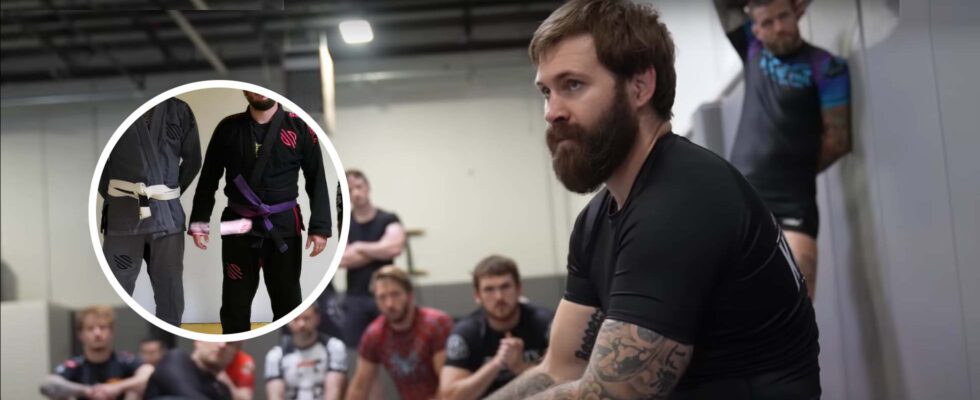
“The reason that you never really see me in danger in competition is because I get submitted every day in training,” Ryan explained. His method involves working with training partners like Silas, whom he describes as “a tough guy like probably a black belt in most gyms” but who holds a purple belt at their academy.
The process is methodical and mutually beneficial. Ryan allows these partners to secure dominant positions and near-finished submissions before attempting his escapes. “Like just let him take my back. Let him put me in fully locked arm bars, fully locked heel locks, fully locked back triangles,” he detailed, emphasizing how he pushes these scenarios to their limits.
This approach creates a unique dynamic where both training partners benefit significantly. When Ryan works his way out of these precarious positions, he provides immediate feedback to his partner about why the submission attempt failed. “I let him put me in a back triangle and then I fight out of it and I’m like oh hey by the way the reason that you didn’t finish me was because X Y Z,” he shared.
The genius of this system lies in its progressive nature. As the lower-ranked partner incorporates Ryan’s feedback and improves their submission attempts, Ryan faces increasingly challenging defensive scenarios. This creates an upward spiral of improvement for both athletes.
Ryan contrasts this method with the limited value of training exclusively with higher-level opponents. When facing someone significantly more skilled, “they’re just gonna finish you” repeatedly, providing little learning opportunity for either party. The sessions become one-sided affairs without the constructive element that makes training productive.
The progression continues as skills develop. What begins with purple belts eventually advances to working with higher-level practitioners. “Now I’m letting Luke put me in a fully locked back triangle letting him take my back and I’m working out of that,” Ryan noted, showing how the principle scales upward.
This training philosophy challenges conventional wisdom about always seeking out the toughest available opponents. Instead, Ryan demonstrates how strategic partner selection can create optimal learning conditions that benefit multiple skill levels simultaneously.
The approach requires both humility and strategic thinking – qualities that have clearly served Ryan well throughout his competitive career. By embracing vulnerability in training, he builds the defensive prowess that keeps him safe when the stakes are highest in competition.
