
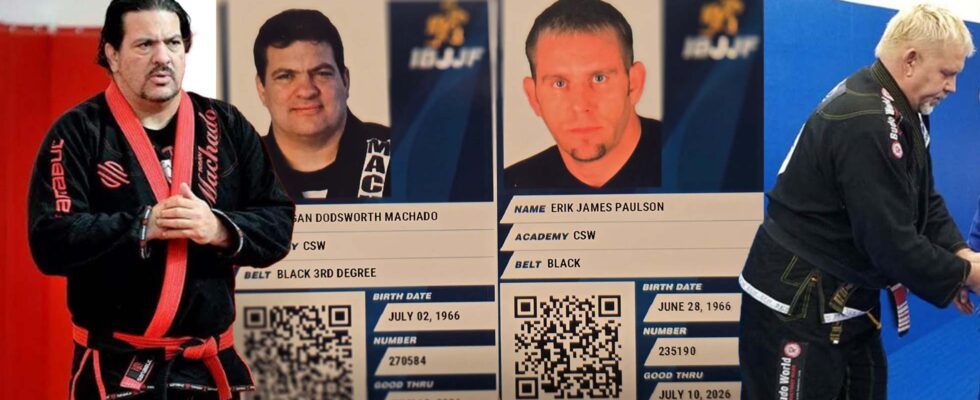
The Brazilian Jiu-Jitsu community was stunned recently when two legendary figures of the sport shared images of their official IBJJF membership cards, revealing rankings that seemed to dramatically undervalue their decades of contribution to the martial art.
Erik Paulson and Rigan Machado, both icons who helped shape modern grappling, posted photos showing their current IBJJF standings: Paulson listed simply as a black belt while Machado appears as a 3rd degree black belt. For practitioners familiar with their extensive histories, these designations raised immediate questions about how the sport’s most visible governing body recognizes its pioneers—or fails to.
Rigan Machado‘s credentials speak for themselves. The eighth-degree red and white belt earned his rank under Carlos Gracie Jr. and boasts an impressive competitive résumé as a former Pan American Champion and veteran ADCC medalist. His contributions to Brazilian Jiu-Jitsu extend far beyond competition, having taught and influenced countless practitioners worldwide. Yet the IBJJF database—where rank is directly tied to ongoing paid membership—lists him far below his actual standing.
Erik Paulson‘s journey in grappling began in 1988. His path through martial arts took him through multiple disciplines, studying Brazilian Jiu-Jitsu under Rorion, Royce, and Rickson Gracie before expanding into ShootWrestling under Yorinaga Nakamura and Catch Wrestling with the legendary Billy Robinson. Despite his 35+ years of influence, he is still listed by the IBJJF without degree recognition—a striking omission that underscores the flaws of a membership-based ranking system.
The discrepancy between their actual achievements and IBJJF rankings highlights a deeper inconsistency in how rank is awarded. The IBJJF, a for-profit organization, operates under rigid guidelines requiring not just time served, but continuous registration, annual fees, and formal promotion requests through certified instructors. These instructors must themselves be IBJJF-certified and two degrees higher than the practitioner they are promoting—effectively locking out non-affiliated veterans from formal recognition.

For coral belts (7th and 8th degree), the timeline extends even further. A practitioner must show 25 years of active black belt status to be considered for a 7th degree, and 32 years for 8th degree. Crucially, these years must be documented through IBJJF’s own system—regardless of how long someone has actually held the rank. The result is a bureaucratic blind spot where legends like Machado and Paulson are treated as if their accomplishments didn’t count because they weren’t filed through the proper fee-paying channels.
In sharp contrast, figures with no comparable lineage or time served have reportedly leapfrogged through the belt system. Moneyberg, received a black belt in 3.5 years, despite IBJJF guidelines that explicitly state a minimum of one year between brown and black belt alone, and years more from white to brown. His rise is just one of many examples where clout and connections seem to override codified timelines—raising questions about whether the rules only apply to some.
This situation raises uncomfortable questions about how federations balance paperwork with principle. Should decades of teaching, pioneering, and global impact be overwritten by expired membership cards? And should rapid promotions—often tied to online fame or business influence—be taken seriously in a system that purports to guard tradition?
Both Machado and Paulson represent bridges between different eras of grappling. They trained with the founders, expanded the art internationally, and adapted to new generations of athletes. That they now find themselves sidelined by a system more focused on administrative compliance than lived contribution is a cautionary tale for the sport’s future.
Ultimately, this disconnect between recognition and reality reveals the fragility of rank in a commercialized system. Titles mean little when they fail to reflect the deeper truths of time, influence, and mastery.
