
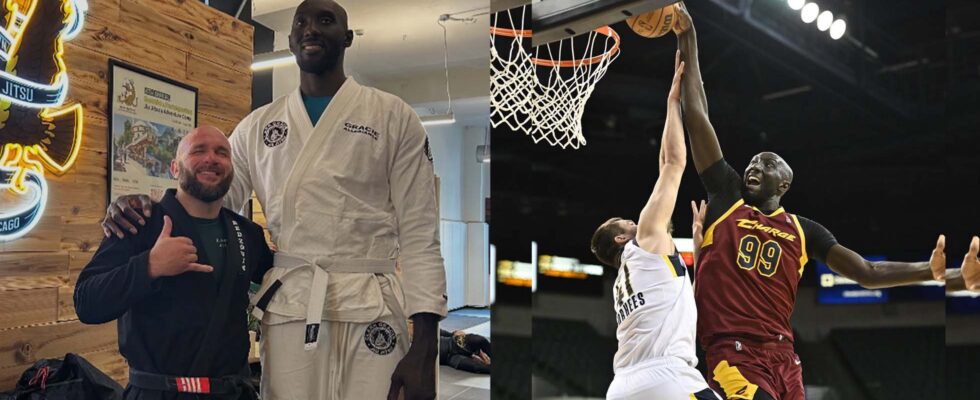
The towering 7’7″ NBA veteran Tacko Fall has embarked on a new athletic journey, trading the hardwood for the mats as he begins training Brazilian jiu-jitsu under the guidance of renowned coach Adem Redzovic at Downtown Jiu-Jitsu Club Chicago.
Fall, who recently concluded his stint with the New Zealand Breakers where he averaged 11.4 points and 6.6 rebounds across 18 games, represents the latest example of professional basketball players exploring martial arts to enhance their athletic development and mental fortitude.
Social media footage from Downtown Jiu-Jitsu Club Chicago showcases Fall’s impressive mobility despite his extraordinary height, working specifically on open guard techniques with Redzovic. The club noted the unique challenge Fall’s physical dimensions present, observing that attempting to navigate past his guard position would prove “very dangerous” for training partners.
This trend of NBA players embracing Brazilian jiu-jitsu continues to gain momentum throughout the league. Boston Celtics head coach Joe Mazzulla has become a vocal advocate for martial arts training, recently explaining how his own jiu-jitsu practice has revolutionized his coaching approach.
“When I got the job I wanted something harder than when I by the time I come into the building I’ve already done something that’s significantly harder than what I’m doing here,”
Mazzulla shared during a podcast appearance with UFC coach Eric Nicksick. The championship-winning coach emphasized how the discipline required on the mats translates directly to better leadership and player relationships.
Mazzulla’s philosophy centers on the psychological honesty that martial arts demands.
“You can hide psychologically in the world today. The one place you can’t hide is in a match,”
he observed, noting how this transparency differs from team sports where individual shortcomings can sometimes be masked by collective performance.
The mental benefits extend beyond mere toughness training. Mazzulla described how his jiu-jitsu sessions create empathy for his players’ struggles.
“It actually humbles me because by the time I get to them, I have a level of empathy for what they’re going through,”
he explained.
“It helps me coach them better. It helps me understand.”
Former NBA All-Star Roy Hibbert, who holds a purple belt in Brazilian jiu-jitsu, exemplifies how basketball players can excel in grappling arts. Hibbert recently demonstrated his versatility by competing against a 400-pound sumo wrestler, showcasing the cross-training benefits that many NBA athletes are discovering.
The appeal of martial arts for professional basketball players appears rooted in the individual accountability it demands. Unlike team dynamics where performance can fluctuate based on teammates’ contributions, grappling arts require complete personal responsibility and presence.
Mazzulla advocates for what he calls a “white belt mentality” — maintaining constant openness to learning regardless of previous accomplishments. This approach particularly resonates with elite athletes accustomed to being the most skilled person in their environment.
“I think sometimes as a coach, you always come into like who’s coaching you when you become the head coach,”
Mazzulla reflected.
“And so, you know, there’s a humility aspect to just getting your a– kicked from time to time, getting coached.”
For Fall, whose recent departure from the Breakers concluded with praise for his “presence, passion, and larger than-life spirit,” Brazilian jiu-jitsu represents an opportunity to channel his unique physical attributes in an entirely new competitive arena. His training under Redzovic‘s expert instruction promises to develop not only technical grappling skills but also the mental resilience that has made martial arts increasingly attractive to elite basketball talent.
As more NBA players discover the transformative potential of Brazilian jiu-jitsu, Fall‘s journey from professional basketball courts to the submission grappling mats reflects a broader evolution in how modern athletes approach comprehensive development both physically and mentally.
