
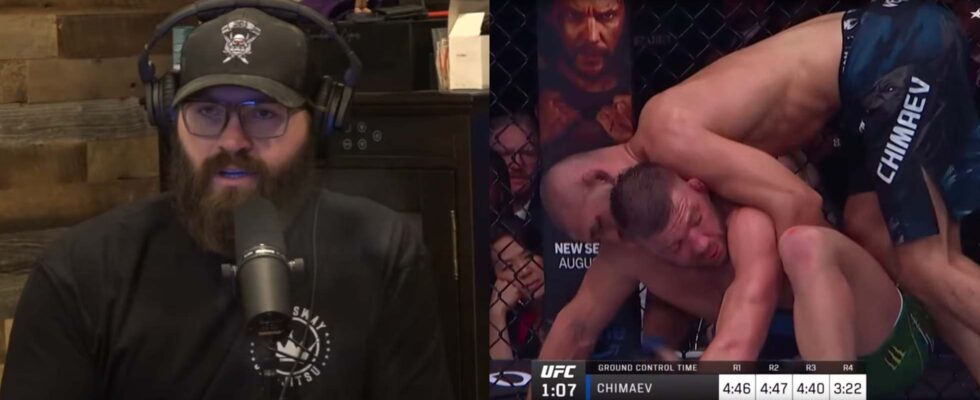
The aftermath of Khamzat Chimaev‘s dominant victory over Dricus Du Plessis at UFC 319 continues to generate heated discussions throughout the combat sports community, with Brazilian Jiu-Jitsu legend Gordon Ryan offering perhaps the most revealing assessment of just how vast the skill gap truly was between the two middleweights.
Speaking on Joe Rogan‘s podcast, Ryan delivered a sobering evaluation of what it would take for Du Plessis to reach competitive levels with Chimaev in grappling exchanges.
“If I work with DDP. Seven days a week for a year, he could be bare minimum competitive with the Khamzat that he competed against. That’s the issue that he needs to split everything up. But right now there’s such as discrepancy in grappling that needs to take priority,”
Ryan explained.
The statement underscores the magnitude of Chimaev‘s performance, where he accumulated over 21 minutes of control time while securing 12 takedowns and landing 529 total strikes. The Chechen wrestler’s dominance was so complete that he managed to secure the crucifix position on three separate occasions, leading to unanimous 50-44 scorecards across the board.
Ryan‘s assessment highlights a fundamental challenge facing mixed martial artists in the modern era: the delicate balance between developing specialized skills while maintaining proficiency across all disciplines. For Du Plessis, who built his championship reign on an unpredictable and awkward striking style, the encounter with Chimaev exposed significant vulnerabilities that would require intensive, focused training to address.
The grappling expert’s comments came amid broader debates about the entertainment value of wrestling-heavy performances. MMA analyst Luke Thomas has been vocal in his criticism of such approaches, arguing that while technically proficient, certain strategic choices can limit both offensive output and viewer engagement.
“If you’re going to compete a game plan where you are that aggressively pursuing chest to chest and chest to back connection, you are making a choice to severely limit any kind of meaningful ground and pound and you are making a choice to severely limit what kinds of submission opportunities are available to you,”
Thomas explained in his analysis of Chimaev‘s performance.
Thomas further criticized the tactical approach, noting that Chimaev
“waved on a bunch of different things that were very accessible that he could have gone to because he was more prioritizing the pancaking control.”
This strategy, while undeniably effective for maintaining dominance, drew scrutiny for its limited offensive threats.
The analyst took particular exception to those who dismiss criticism as casual fan perspectives.
“The audacity of people out there, grapplers and media alike, you’re like if you don’t like this you’re a casual. No, you’re a [censored] casual,”
Thomas stated emphatically.
His technical critique centered on the limitations inherent in Chimaev‘s chosen approach:
“You cannot pass in MMA with both knees on the ground and you cannot ground and pound making chest to chest contact. So what is your offense from there? You made a choice to have minimal offense in favor of maximum positional control.”
Despite his criticisms, Thomas acknowledged the skill required for such dominance.
“I have plenty of appreciation for the skill it took to do that kind of a thing,”
he noted, while maintaining his position that the entertainment value and tactical choices remained problematic from a spectator standpoint.
However, Thomas framed his argument around mixed martial arts being an
“offense first sport,”
suggesting that prioritizing positional control over attacking opportunities represents a fundamental departure from what makes the sport compelling to watch.
Ryan‘s assessment that Du Plessis would require a full year of intensive grappling training just to reach basic competitive levels speaks to both Chimaev‘s exceptional abilities and the South African’s current limitations on the ground. The challenge becomes even more complex when considering Ryan‘s observation that Du Plessis must simultaneously maintain his other skills while addressing this significant weakness.
