
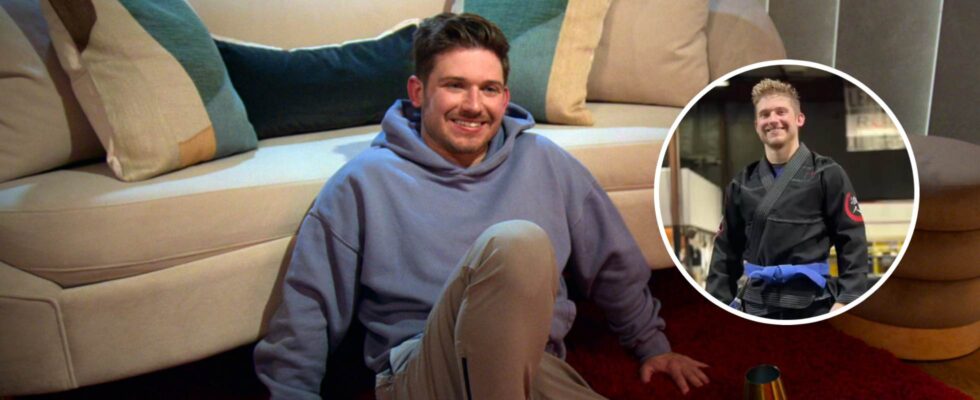
When Love is Blind Season 10 cast its net across Ohio, it pulled up Chris Fusco. The 33-year-old arrived with a particular brand of confidence that viewers quickly found difficult to stomach.
Before the season even aired, his social media presence had gone quiet, wiped clean, leaving curious fans little to work with. As the episodes rolled out, his reputation built itself just fine without any help from his profiles.
Among the questions that found their way to viewers and commentators was a simple one: was Chris Fusco actually a jiu-jitsu practitioner, or was the whole identity a bit of personal branding? A TikToker decided to dig in and find out.
— calfkicker (@calfkickercom) March 11, 2026
The investigation started with Fusco’s own promotional bio, which described him as someone who, when not “dominating people on the mats in jiu-jitsu,” was presumably doing other things.
The only image the TikToker was able to locate from his time training showed Fusco as a blue belt with one stripe at his gym, Ronin Academy. Based on the visible rank and what is typically understood about belt progression in Brazilian jiu-jitsu, the TikToker estimated that at the time the photo was taken, Fusco had probably been training somewhere between three and four years.
A blue belt generally takes the average practitioner around two years to earn.
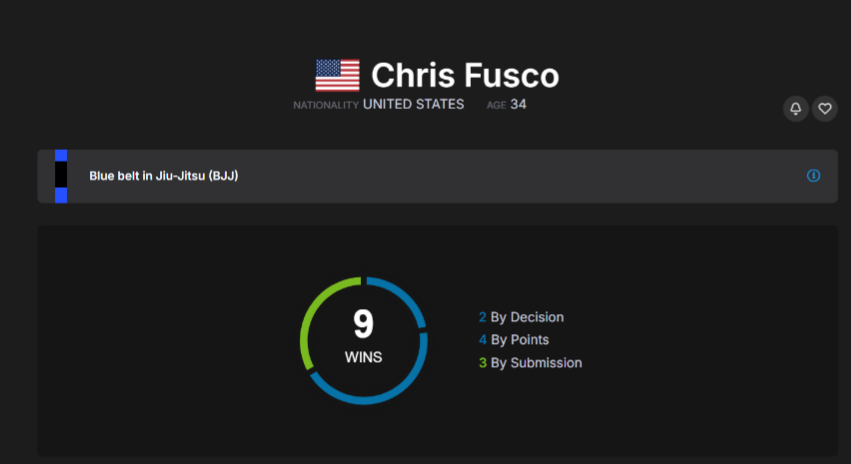
His competition record, pulled from Smoothcomp, the database where jiu-jitsu results are archived, told the rest of the story.
Under the name Chris Fusco, age 33, the profile showed nine wins in total. His first appearance in competition came in 2019 at a Grappling Industries event in Columbus, where he entered as a white belt in the 155 pound (70.3 kg) weight class. He went on to win gold in his division that day, posting a mix of submission and decision victories.

His next documented appearance came on March 5, 2022, at a Grappling Industries event held during the Arnold Classic. He went on to win several of his matches there by points and by decision before running into a competitor named Buzz Stokes, who submitted him.
A look at Stokes’ profile revealed a detail that reframes the loss entirely: at the time they competed, Stokes was approximately 17 or 18 years old and was himself a blue belt. He has since continued competing and is now ranked as a purple belt.
As the TikToker pointed out, a teenage blue belt is a genuinely different challenge from an adult blue belt. Young competitors who reach that rank have typically been training for years and carry a level of athleticism that makes the matchup difficult for anyone across from them. Losing to someone in that position carries no particular embarrassment.
After the 2022 event, there is no further competition record to examine. The TikToker was careful not to draw too firm a conclusion from that absence.
The blue belt phase of jiu-jitsu is, in fact, the rank at which many practitioners step away from the sport. The physical demands become more intense, life intervenes, and the transition from beginner to serious competitor takes a toll. It is a widely recognized pattern in the sport.
The harder part to credit was what viewers saw of Fusco on camera.
His time on Love is Blind Season 10 provided a concentrated display of exactly the kind of behavior that pushes audiences to choose a side quickly.
According to sources, Fusco’s self-presentation was built around the idea that he occupied a special tier of desirability. During a broadcast, he told viewers directly: “I was one of the first people who’s like actually a stud who kills in all ways and I know it hurts. If I saw me drive by, like if I pulled up the way I pull up, I would be impressed by me.”
He made his understanding of romantic relationships equally clear: “You should be able to pull so many chicks and choose her. I literally chose. I get any chick I want.”
His worldview extended to a particular theory of male worth. “If you can’t pull chicks, your chick knows you’re a loser. Straight up,” he said.
Men who lived more quietly were not spared: “You guys who don’t party, who haven’t like lived a life like that, they’re not social people. You guys are weird.”
When his audience did not respond the way he anticipated, his composure slipped noticeably. Rather than recalibrate, he redirected toward extended criticism of the people in his chat, framing them as beneath him. That reaction revealed considerably more than any rehearsed declaration could.
On the show itself, his conduct toward the women he was supposedly building genuine connections with was equally telling. When confronted about telling castmate Jessica that she did not meet his physical standards, he offered a response that dressed cruelty up as directness: “I wasn’t trying to be mean. I was trying to be dominant and tell you the truth.”
He added, “I’m used to being with somebody who works out every day,” reducing her value entirely to her physical condition.
He then informed Jessica that he had spent two days thinking about what life would have looked like with another castmate, Bri. There was no constructive purpose in sharing that information. It served only to communicate to Jessica that she was replaceable, while allowing Fusco to position himself as someone doing her a favor by staying.
At a group outing, Fusco approached Bri directly while she was present with her fiancé Connor. He told her, “I saw you and I was like, that is the girl like I would literally propose to,” before asking outright, “Are you attracted to me?” He followed that with, “I felt like we would have been like f**k buddies.”
Connor appeared to be an afterthought throughout the entire exchange. Fusco then offered unsolicited advice: “I feel like you need someone who’s going to be more dominant in your life and to help you,” a remark that arrived moments after his question about her attraction to him.
When comparisons to controversial public figures began circulating, Fusco did not appear particularly concerned. “I’m Andrew Tate, apparently. The crazy Andrew Tate guy,” he said.
The season closed out for Fusco with a line that functioned as an unintentional summary of everything preceding it. Looking at Jessica, he said: “I know you dislike me. A lot of people have said that in my life.” No reflection followed.
