
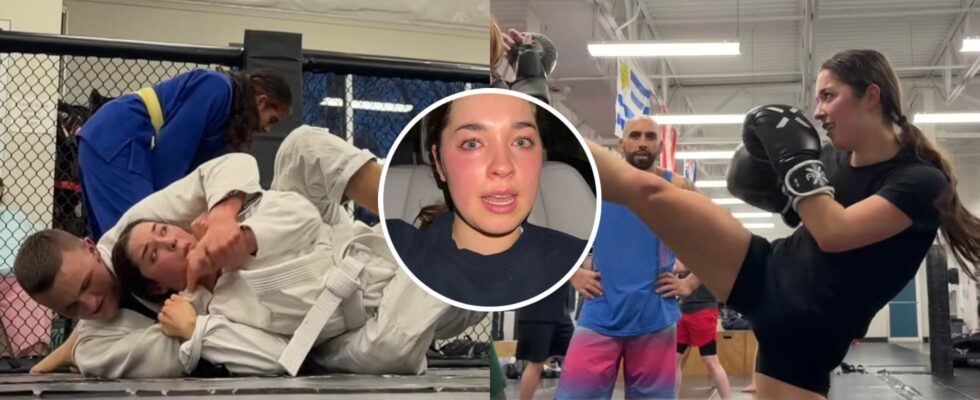
Riley Rehl has spent eight years doing Body Combat, a mixed martial arts-inspired group fitness class she describes as “shadow boxing set to music.” Confident in her abilities, she set out to answer a question that had lingered in the back of her mind: does being good at Body Combat translate to being good at traditional martial arts?
What followed would highlight a hard truth many seasoned combat sports athletes already understand: choreographed fitness routines rarely prepare you for the physical and technical realities of actual combat sports.
For 30 days, she attended classes in MMA, Muay Thai, and Jiu-Jitsu, and what she discovered brought her to tears.
Her first night at the gym included an MMA class followed by Muay Thai. She quickly noticed that while she recognized the names of movements from Body Combat, executing them in a real training environment was an entirely different challenge.
During a Muay Thai session, a coach pulled her aside with two blunt corrections: “Stop dancing” and “relax your shoulders.”
Jiu-Jitsu, however, proved to be the steepest learning curve. Her first class was immediately derailed by a wardrobe issue. She arrived without a gi, which made rolling through the movements far more uncomfortable than it needed to be.
Once she had the right gear, she dove in fully and the experience quickly became her favorite part of the challenge.
The moment that truly tested her came during week three, when she was rolling with a 14-year-old student who went considerably harder than anyone else she had faced.
“I got choked out by a 14-year-old kid in class today,” she said. “He was just like being super rough. Thankfully, the adult coaches were like, ‘Take it easy.'”
The incident left her shaken and visibly emotional. “There is something scary about being in a vulnerable position, putting myself in these positions where I don’t know how to get out of them,” she reflected.
It became increasingly clear that familiarity with martial arts terminology from fitness classes did not translate into functional skill once resistance, timing, and real pressure were introduced.
Coaches stepped in after the incident and advised her to roll with colored belts rather than white belts, explaining that more experienced students are not looking to prove anything to anyone.
By week four, Jiu-Jitsu had become the clear standout. “Today’s Jiu-Jitsu class was so good. I felt like for the first time this entire month, things are starting to work for me,” she said.
Hearing a training partner say “good roll” after a session became one of the most meaningful moments of the entire challenge. “To me, that meant that I was getting better.”
Looking back, Riley acknowledged that Body Combat gave her some familiarity but not nearly the foundation she had expected.
“I think my background in Body Combat helped a little bit, but I definitely was still a beginner.” The month ultimately reinforced the clear divide between workouts inspired by martial arts and the disciplined craft of actually practicing them.
