
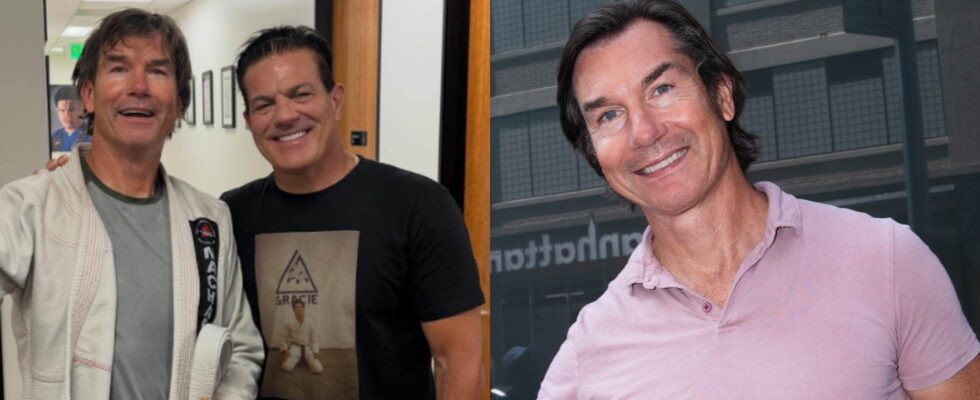
On a recent episode of The Small Bow podcast, actor Jerry O’Connell opened up to host AJ Daulerio about his experiences training Brazilian jiu-jitsu, including the physical toll and the unexpected mental clarity the sport brings.
O’Connell arrived at the recording session still feeling the effects of a rough training day.
“I got beat up so bad in jiu-jitsu the other day,” he told Daulerio. “Some guy beat me up so bad.”
Despite that, he made it clear that jiu-jitsu has become a meaningful part of his routine.
“Some guy did something to my neck,” O’Connell added. “Love it though. It’s the best thing. Why is it so fun?”
Daulerio then shifted the conversation toward the psychological side of training, explaining that he sees parallels between jiu-jitsu and recovery from addiction.
“Here’s the thing, and I really want to find someone who can explain this,” he said. “I would love to find someone in recovery who does jiu-jitsu and talk about the parallels about why it helps so much.”
He described the mental relief he experiences during training as a form of escape from everyday stress.
“I actually don’t think about anything when I’m there for that hour and a half,” Daulerio said. “I never want to think about my phone. Never want to think. It’s just empty.”
O’Connell credited his instructor, Jean-Jacques Machado, for shaping his experience on the mats and helping make training enjoyable despite the challenges.
“I got to give a shout out to Jean-Jacques Machado in the valley,” he said. “He’s the best. That’s my professor. I love him.”
Daulerio joked that he hesitates to promote his gym publicly because of how he believes others there view his skill level.
“I don’t tell people about it because I think everyone there at the gym thinks I suck so bad that I shouldn’t be representing the gym,” he said, laughing.
O’Connell gave his take, saying, “I’m the worst in there. But they’re really nice to me.”
One of the most memorable lessons Daulerio shared came during his second month of training, when a partner caught him in a guillotine choke.
“I tap and I tap early,” Daulerio recalled. “The guy’s like, ‘Why did you tap?’ And I said, ‘Well, cuz you were choking me, obviously.’ And he’s like, ‘It wasn’t tight.’ And I’m like, ‘Oh.’ And he’s like, ‘If you have space to breathe, you have space to escape.'”
“I kind of apply that to so many things now,” Daulerio said. “It’s crazy.”
However, O’Connell admitted that when he’s caught by more experienced grapplers, survival instincts take over quickly. “Yeah. I just tap. I’m out of there,” he said. “I just give up. It’s over.”
He also described the humbling clarity that comes from being controlled by a higher-level practitioner, a reality familiar to anyone who has rolled with a seasoned black belt.
“When you’re underneath a black belt, it’s over,” O’Connell said. “There’s nothing you can do. You got to tap. You got to give up. You got to surrender. It’s over.”
