
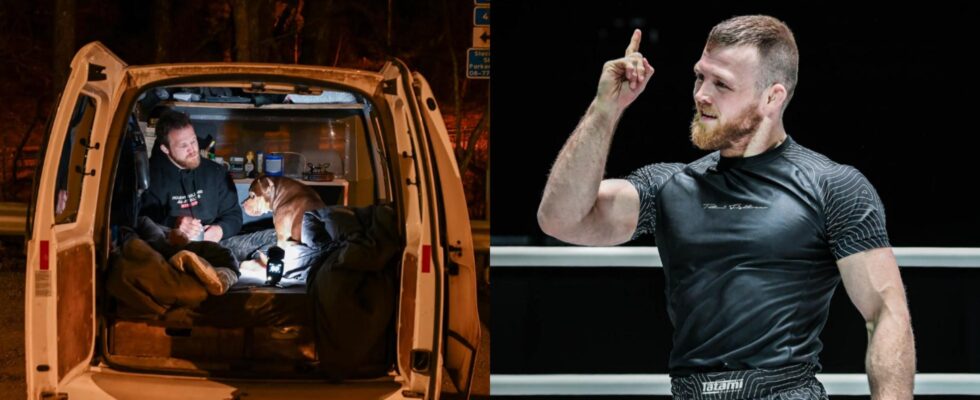
Brazilian jiu-jitsu star Tommy Langaker recently opened up about the personal struggles he faced behind the scenes of his competitive success, including coke dependency, depression, and the emotional crash that followed the biggest win of his career.
In an interview, the former IBJJF world champion reflected on the years after winning gold at the 2023 IBJJF World Championship in Las Vegas, explaining how his life gradually unraveled despite continuing to compete at the highest level of the sport.
At the 2023 IBJJF World Championship in Las Vegas, Langaker defeated Michael Perez to win the biggest title of his career. Looking back on the match now, he remembers it as one of those rare days where everything worked.
“It was a good day where everything just clicked,” he says. “I started getting frustrated because he kept pulling away, but in the end I did it.”
Winning the world title had been his goal for years. For a brief moment, it felt like everything he had worked toward had finally paid off.
But the feeling faded faster than he expected.
“It was one minute of happiness, and then the crash,” he says. “On the podium when I received the medal, I almost had to fake the joy. Inside I just felt: ‘Was this all…?’ It was an awful feeling.”
In the years that followed, Langaker says his life slowly unraveled. Despite becoming one of the most recognized names in Brazilian jiu-jitsu, he privately struggled with d*ug dependency, isolation, and depression. By early 2026, he was living out of a van in Stockholm with his dog, Anouki.
Now 32, the Norwegian grappler says he wants to speak openly about that period of his life because he knows many people deal with similar problems in silence.
“People saw the world champion and the athlete,” he says. “They didn’t see the person struggling alone.”
Langaker grew up in Haugesund, Norway, and became known locally as one of the country’s top jiu-jitsu talents. He says he always had an obsessive personality, something that pushed him to succeed in competition but also made him vulnerable in other ways.
“I have always been fixated on being the best at things. I wanted to be the best in jiu-jitsu, and then the same thing happened with the d**gs too.”
He had experimented casually with m**ijuana from around the age of 22, but says that was never the real source of his trouble. It was during the COVID pandemic, bored and ground down by inactivity, that his path fundamentally changed.
“The first time I was offered c**aine, I just said yes. In the beginning that also felt harmless.”
Other narcotics followed, then more after that.
“I became obsessed with the feeling. It wasn’t that I wanted to die. I just wanted to stop feeling things all the time.”
Even while struggling privately, he continued training and competing at a high level. He says that because his performances remained strong, he convinced himself the situation was still under control.
“As long as I was still performing, I thought it couldn’t be that serious.”
Eventually, Langaker relocated to Stockholm and began training and coaching at Prana Jiu-Jitsu. He hoped the move would help create distance from old habits and environments, though he admits recovery was far from straightforward.
A turning point came earlier this year during a trip to Las Vegas, where he had traveled to support a teammate at a competition. After another episode involving heavy d*ug use, he says he finally realized he could not continue living the same way.
“That was the moment where I understood I had enough,” he says.
What had started as an occasional escape gradually became a compulsion. The social became solitary. The frequency crept upward without triggering whatever alarm he had expected to sound.
“If you had told me five years ago that I would end up living in a van because I was trying to save my life from d**gs, I would have laughed in your face.”
Langaker also spoke about the strain his struggles placed on people close to him, including his former partner, a Swedish jiu-jitsu competitor. He says shame caused him to isolate himself and avoid difficult conversations.
“I started isolating myself a lot. Not because I wasn’t in love with her, but because I was so ashamed.”
Throughout the interview, Langaker stresses that his use was never related to athletic performance enhancement. He says it was instead tied to mental health struggles and emotional avoidance.
“I used dr*gs to avoid feeling things,” he explains. “That’s completely different from trying to gain an advantage in competition.”
He says he was regularly tested throughout his career while competing under organizations including ONE Championship and at major IBJJF events, maintaining that he always competed clean.
At the same time, Langaker believes many athletes quietly deal with issues that fans rarely see.
“Sports often focus on perfect success stories,” he says. “But a lot of athletes carry loneliness, pressure, or other personal struggles behind the scenes.”
Despite everything that has happened, Langaker plans to compete again at the upcoming IBJJF World Championship in Long Beach, California, nearly two and a half years after winning gold in Las Vegas.
He understands that some people may judge him for speaking publicly about his experiences, but says honesty matters more to him now than maintaining a perfect image.
“I know some people will be disappointed,” he says. “But I’d rather be honest about it.”
[Editor’s Note: Quotes have been translated and edited for clarity.]
