
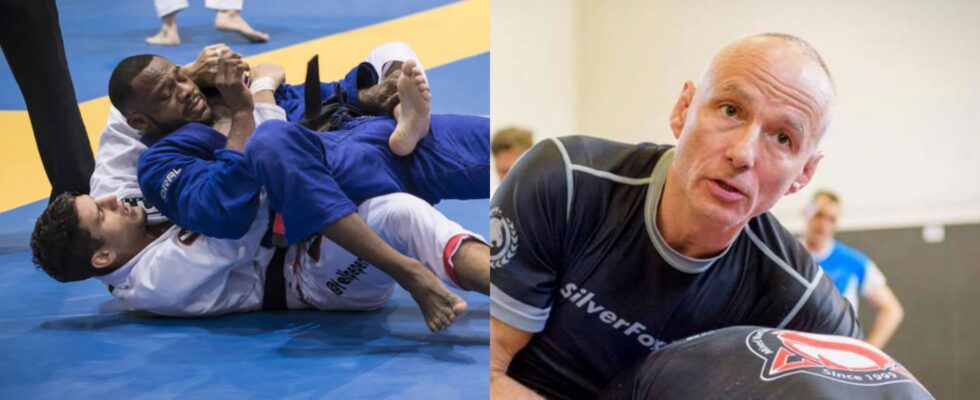
Karel Pravec, a fifth-degree Renzo Gracie black belt and longtime jiu-jitsu instructor based in New Jersey, recently shared his thoughts about the possibility of BJJ one day becoming an Olympic sport during a podcast conversation.
Pravec made it clear that he sees jiu-jitsu as something bigger than a standardized competition system.
“I am a fan of this as an art,” Pravec said. “I hope this never makes it into the Olympics because I want it to stay in art because with art and different rule sets, people can express themselves.”
He explained that the freedom created by multiple rulesets allows unconventional styles to either fail naturally or gain traction based on effectiveness rather than conformity.
“If they’re sort of such an oddball that nobody believes what they’re doing, nobody’s going to follow them,” he said. “But if you sort of have an effective style and you start, the world or the people around you start to see it as such, they’re going to try to learn that way.”
For Pravec, that constant experimentation is what has always separated jiu-jitsu from more rigid combat sports structures.
“So I think I like the different rule sets,” he continued. “I like the fact that it’s sort of unorganized and I want to stay that way.”
Later in the interview, Pravec expanded on why he believes Olympic inclusion could fundamentally change the culture of the sport. According to him, a single governing ruleset would eventually push athletes and coaches toward a far more conservative style of training.
“I really am a big fan of multiple rule sets because if you have a single rule set, that would be my fear,” Pravec said. “If it got into the Olympics, everybody along the way, especially some countries that support Olympic sports, it becomes the default martial art in that country.”
He argued that once governments and Olympic systems begin supporting a sport financially, athletes inevitably optimize for medal-winning strategies rather than innovation.
“But what happens then, everybody trains according to that rule set,” he explained. “Which starts to really get away from innovation and more towards, okay, there may be tiny innovations, but more importantly it becomes a very conservative approach to that martial art.”
Pravec contrasted that approach with the culture he believes historically defined Brazilian jiu-jitsu.
“Whereas Brazilian jiu-jitsu always had a very innovative approach to it,” he said.
To support his concerns, Pravec pointed to judo as an example of how Olympic governance can reshape a martial art over time.
“I think in the Olympics, you saw what happened with judo where they banned double leg takedowns,” he said. “And I think that has the possibility of happening with jiu-jitsu too.”
Toward the end of the discussion, Pravec circled back to the same core idea: preserving the openness and experimentation that he believes keeps BJJ evolving naturally.
“This is one of the reasons I wanted to stay in art,” he said. “I don’t want it to become a unified sport.”
He again stressed that different organizations and rulesets allow techniques and strategies to succeed or disappear organically without a single authority controlling the direction of the sport.
“I think everybody can play around with the rules and if everybody thinks it’s trash, it’s going to end on its own,” Pravec explained. “But if it’s sort of good where enough people like it and want to look at it and follow it and try it, then it’s going to evolve.”
“And I think the way BJJ is run right now is good.”
