
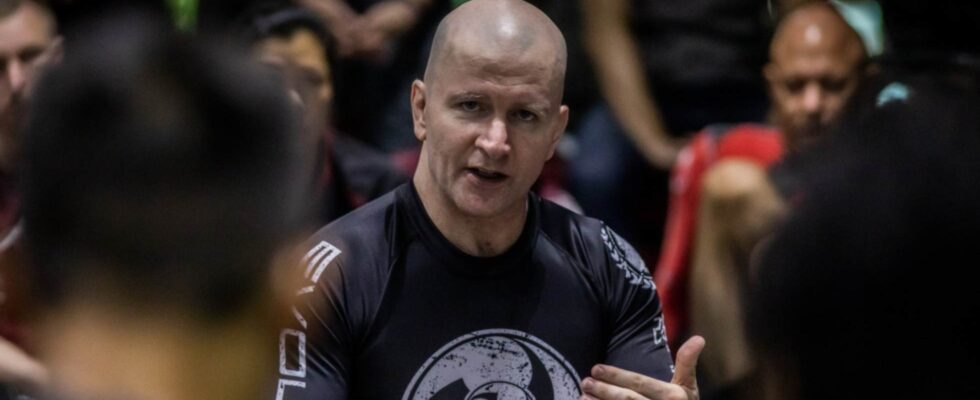
During an episode of the Lex Fridman podcast with John Danaher, Fridman mentioned that Reddit users often asked about a man named Boris. He is allegedly a former student of John Danaher at the Renzo Gracie Academy in New York who had developed something of a cult reputation in grappling circles.
Danaher’s answer offered a detailed portrait of one of his earliest and most memorable students.
“Boris is one of my early students,” Danaher said. “I think he was either my first or second black belt.”
Boris, he explained, came from Long Island, had a wrestling background, and was of Russian Jewish descent. He stood out to Danaher not just for his athletic ability, but for his intelligence and personality. Physically, he was short but extremely powerful and compact.
“Very nice, polite young man, but also slightly eccentric, which I always liked about him,” Danaher said.
That eccentricity, Danaher recalled, often showed up outside the gym. Boris would leave training dressed, in Danaher’s words, “like a complete nerd, with his pocket protector.”
Despite being heavily muscled and physically imposing, he intentionally presented himself in a way that concealed it entirely.
Danaher stated, “He was heavily muscled but he would dress in such way that it didn’t appear so when he left. And we always used to laugh like you imagine some guy tried to mug Boris. They would see him with his with his nerdy glasses on his pocket protector and they would literally run into like one of the most formidable human beings in the entire New York area.”
Boris had originally begun training in jiu-jitsu on Long Island, and later continued when he took a tech job in Manhattan, joining Danaher’s early morning classes.
“He and a group of others, a very small group, used to train early in the morning around 6 a.m. before work,” Danaher said.
During that period, a young Georges St-Pierre was also part of the same training group, and Boris quickly became one of his key sparring partners. Danaher structured their roles deliberately: he encouraged St-Pierre to work from the bottom position, while Boris, known for his strength in top control and guard passing, would consistently dominate from above.
“I remember one of George’s happiest days,” Danaher said, “is finally, after like two years, one day he got on top and finished him.”
According to Danaher, that moment marked a rare breakthrough and, as it turned out, the last time it ever happened.
Boris also held a very firm and unusual philosophy about aging and training.
“Every time we would have a conversation,” Danaher recalled, “he would say, I’m only going to do the sport until I’m 40 years old and then I’m going to stop.”
Danaher tried to challenge that belief, pointing out that Boris had the skill and experience to continue for decades. But Boris remained unmoved.
“It’s ridiculous for a man to train after 40,” he would say. “There’s no need.”
What stood out to Danaher was not that Boris had a detailed justification, but that he didn’t. It was simply a fixed conviction.
Then, one day after training, Boris walked up to him with a matter-of-fact announcement.
“Hey John, I just turned 40. So I won’t be seeing you again.”
Danaher initially assumed he was joking.
“I’ll see you tomorrow, Boris,” Danaher replied.
But Boris was serious. “No you won’t,” he said, before walking away. He never returned to the gym.
“He was one of the best grapplers I ever saw,” Danaher said. “And just, that’s it, buddy, I’m out.”
