
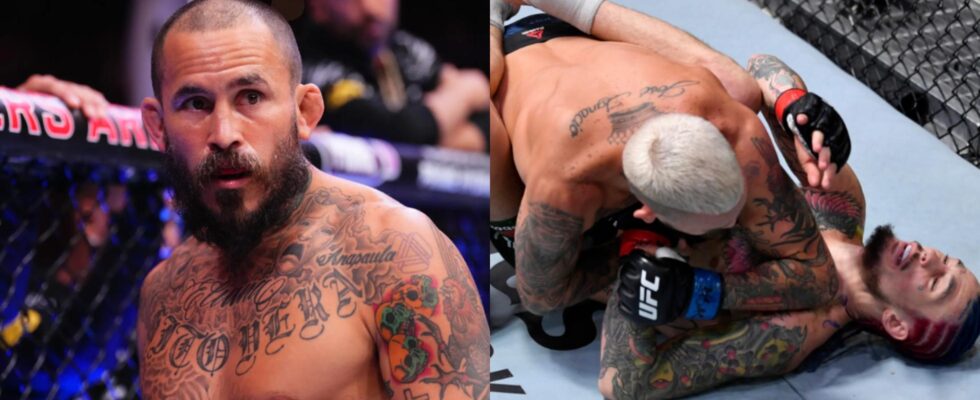
On an episode of Brandon Moreno’s podcast, the former UFC flyweight champion sat down with bantamweight contender Chito Vera for a discussion about training, grappling, and what skills truly matter in modern MMA.
The conversation turned toward Vera’s recent evolution in training. He explained that he has been spending less time on traditional jiu-jitsu and focusing more on MMA-specific grappling alongside high-level wrestlers.
According to Vera, the experience has changed the way he views ground fight ing.
“If we spend two or three months training in those positions inside the cage, nobody will be able to do much against us,” Vera said.
He argued that even elite wrestlers would struggle to keep control against someone who develops that kind of pace and scrambling ability.
“Because the only ones who can do anything to us are wrestlers like Merab, wrestlers like Umar, but they’re not going to submit you, they’re going to control you,” he continued.
Vera then explained why he believes constant movement and grappling exchanges are the key to neutralizing those advantages.
“But with that jiu-jitsu and that level of pace of attacks and movement, nobody can control you because you stand up to those wrestlers and they’re not going to be able to handle it.”
When discussing how athlete should allocate their training time, Vera was blunt about what he considers the most difficult aspect of MMA.
“The hardest part of MMA is the ground game,” he said. “Striking, you learn striking quickly. Striking is relatively easy to learn, and if you have the guts and keep your chin down, nothing bad will happen.”
The Ecuadorian also spoke about the amount of grappling work required to remain competitive at the highest level. He questioned the common approach of prioritizing striking while limiting time spent wrestling and grappling.
“I always tell athletes this: some people say, ‘I strike every day because it’s the safest thing to train. I wrestle twice a week and do jiu-jitsu twice a week,'” Vera said.
He then explained why he believes that isn’t enough.
“But to compete at the highest level, don’t you need to be grappling at least four or five times a week? Every match eventually gets there. Even if your opponent isn’t an elite wrestler, they’re still going to try to take you down.”
That led Vera to summarize the main point he had been building toward throughout the discussion.
“The truth is, I don’t like to say it because I’d like to be a striker my whole life, but wrestling is the most important thing,” he said.
Moreno immediately agreed.
“Yeah, I totally agree. It’s the most important thing,” Moreno responded.
The former champion then reflected on a question he frequently receives from fans who watch his gaming broadcasts.
“A lot of people ask me, because I str3am video games and many times guys ask me, ‘Hey, what do you recommend I train, bro?'” Moreno said.
His answer mirrors Vera’s view of the sport.
“If you have the chance, do wrestling or jujitsu. And if you can, wrestling, because striking is relatively easy to train. At the end of the day, striking is just throwing punches.”
To reinforce his argument, Moreno pointed to lightweight contender Arman Tsarukyan as an example of how elite wrestling can compensate for other areas.
“Arman isn’t like a striker, he’s not the most flashy striker,” Moreno said.
Yet despite that, he has consistently found success against dangerous stand-up specialists.
“But he’s beaten athletes who are excellent stand-up specialists: guys with great guards, knockout power, flexibility, and dangerous kicks. That’s where wrestling changes everything.”
While striking may get the attention, wrestling remains the foundation that allows athletes to dictate where a fi ght takes place and ultimately determines success at the highest levels of MMA.
[Editor’s Note: Quotes have been translated and edited for clarity and readability.]
