
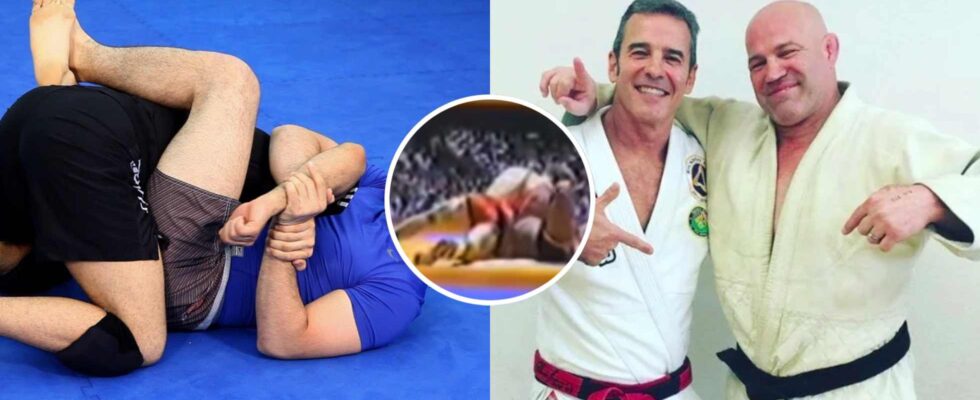
At the 1984 Los Angeles Olympics, Mark Schultz applied a kimura that broke his opponent’s arm and prompted officials to introduce a new rule during the tournament itself. Speaking on the MMA History Podcast, Schultz looked back on the controversial moment and the events leading up to it.
Competing at 181 lbs (82 kg), Schultz was handed one of the toughest draws imaginable in the opening round. His opponent was Turkish wrestler Reşit Karabacak, one of the most accomplished competitors in the field.
“The Turk was ranked number one in the world. Reşit Karabacak was the European champion. He beat all the Russians who boycotted the Olympics and now I got him,” Schultz recalled.
The draw only made matters worse. Schultz explained that the two ended up on a collision course immediately.
“I pulled out the number six. And Karabacak standing right behind me, he weighs in and he pulls out the number eight. So on the even side of the bracket, first match, two wrestles, four or six wrestles eight. I have the gold medal match. My very first match. I am scared out of my mind, for lack of a better term.”
The pressure weighed heavily on him in the hours before the bout.
“I go back to my hotel and I just stare at a wall for two hours, just waiting for this man, just sweating, just sitting and staring,” Schultz said.
When the match finally began, Karabacak attacked with a high crotch takedown. Schultz immediately recognized an opportunity based on something he had previously seen from a Cuban wrestler, even though he had never attempted the technique himself in competition.
“I had never done it in practice or competition,” Schultz said. “I used to do that move all the time with the guy’s head on the inside, where I would grab the double wrist lock and then pull his head and pull his arm up so his head was trapped right below. He couldn’t back out. He was trapped.”
While he was familiar with a variation of the move, using it against a high-level Olympic opponent was completely uncharted territory.
“So I’ve done that move a lot with the head on the inside, but I never did it with the head on the outside.”
Despite the uncertainty, Schultz committed to the technique.
“It was go time, you know, him or me. And I said, ‘It’s going to be me,'” he recalled. “And I just threw it.”
The move did not unfold the way he expected.
“Instead of him flipping head over heels, he hit his head, stopping his momentum. And I just held on the arm and just snapped his elbow instantly. I land on top of him. I’m looking back at the ref like, ‘Hurry up and call the fall’ before they find out what I did.”
According to Schultz, tournament officials reacted immediately after the match by creating a rule that did not previously exist.
“That double wrist lock that I did on the Turk, there’s no rule against that,” Schultz said. “They made that rule up after that match. Right after the match.”
He continued by explaining the new restriction.
“They created a new rule right after the match saying that the arm cannot be taken beyond a 90-degree angle.”
Schultz maintains that he never violated any existing rule.
“If you look at the match and look at his arm, his arm is right at 90 degrees when it breaks. There was no rule before that match. There was no rule.”
Karabacak eventually filed a protest over the result, but by that point the tournament had already moved forward.
“They gave the match to him, but they didn’t kick me out of the whole tournament,” Schultz said.
In the end, Schultz felt the outcome still favored him.
“I won the war. He won the battle.”
