
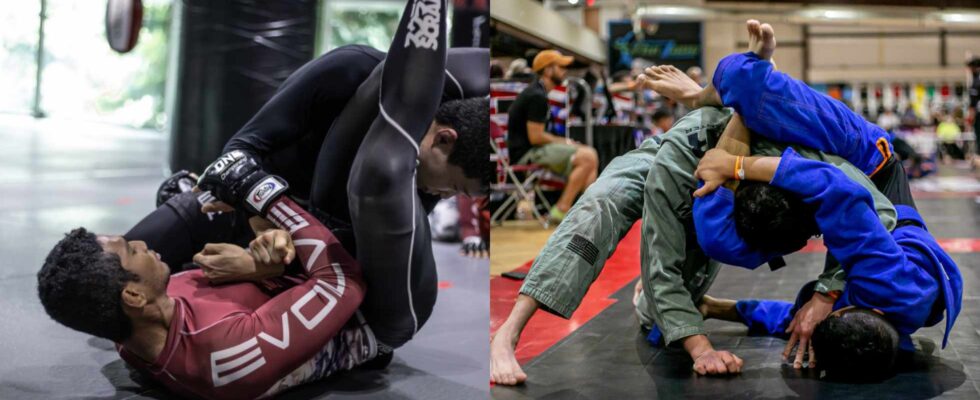
Robert Drysdale, a Jiu-Jitsu world champion, ADCC veteran, and historian, has a clear message for those predicting the end of gi jiu-jitsu: the numbers do not support it.
Speaking on a podcast, Drysdale pushed back against the popular narrative that no-gi has taken over the sport. In his view, the perception is driven by a vocal online minority, not by what is actually happening on mats around the world.
“When people say the gi is d3ad, I think it’s good marketing, but it’s absurd,” Drysdale said. “You go to Masters Worlds Jiu-Jitsu Con, and you’ll see 15,000 competitors there in the gi.”
For Drysdale, the confusion comes from how loudly the no-gi community promotes itself on social media. Because that content dominates platforms like Instagram, many practitioners get the impression it represents the entire sport. In reality, Drysdale estimates no-gi competitors make up a small fraction of the overall community.
“We’re talking like 5% of the community here, maybe. It’s a small minority,” he said. “Because they have such a strong presence online and they’re so militant about manipulating algorithms and advancing themselves that way, there’s a young generation of kids watching that and they’re going, ‘That’s what I’m supposed to be.'”
Drysdale also pointed to a demographic reality he believes will keep gi jiu-jitsu dominant for the foreseeable future. The no-gi professional scene, he argued, skews young and male. As practitioners age, their preferences tend to shift.
“As you get older, you’re going to prefer the gi. Trust me,” he said.
He views the IBJJF’s gi competition model as fundamentally more inclusive than the no-gi scene, with divisions for all ages, genders, and experience levels. That broader reach gives the gi a structural advantage that online noise cannot override.
“The IBJJF gi model will always be bigger because they have a much bigger demographic to approach,” Drysdale said. “The no-gi will be an environment primarily consisting of young males.”
That is not a critique of no-gi training itself. Drysdale’s competitive philosophy has always been that jiu-jitsu should work everywhere, gi, no-gi, and in MMA. But he draws a distinction between training no-gi and the idea that it is somehow displacing the gi as the face of the sport.
“I travel the world. The gi is wildly more popular than no-gi. It’s not even close,” he said.
For Drysdale, practitioners calling the gi obsolete are simply not looking beyond their own corner of the internet. The actual training rooms, tournament brackets, and academies across the globe tell a very different story.
