
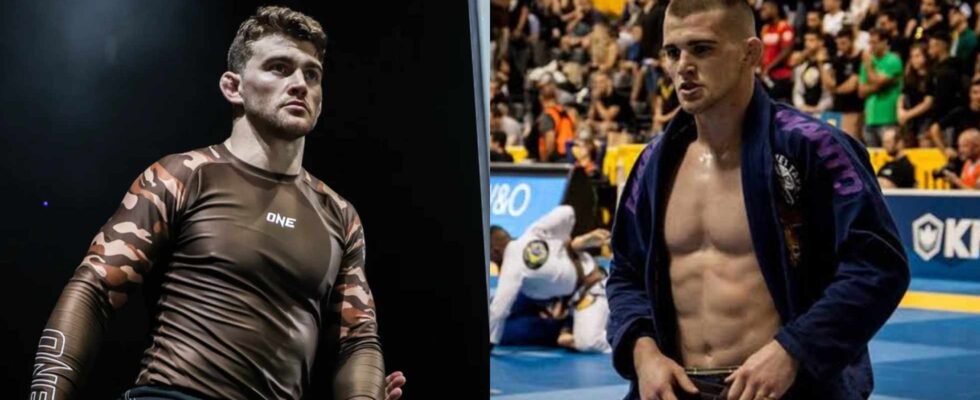
Dante Leon grew up training jiu-jitsu almost entirely in the gi. In the mid-2000s, when he first started competing, no-gi was an afterthought at most academies. He recalled how the schedule was “mainly gi every day or every week, and then there would be like a Friday or Saturday no-gi day, and it’d be the smallest class in the gym.”
Despite eventually becoming one of the top no-gi competitors in the world, with an ADCC semifinal appearance and multiple championship victories on the global circuit, Leon remains firm in his belief that the gi is where serious jiu-jitsu development starts.
“I still believe the best way to get good at jiu-jitsu is starting in the ghee,” Leon told Jits and Giggles host Alysa Couce. “And I think the people who are good in the gi are the best in no-gi.”
His own career reflects that philosophy. Leon came through the IBJJF circuit, winning at Pan Americans as a juvenile blue belt before earning back-to-back bronze medals at NOGI Worlds and eventually winning the title in 2019.
The technical discipline built through years of gi competition, where grips, structure, and positional precision are central, carried over directly when he shifted his primary focus to submission grappling.
Leon extended the argument to athletes who train no-gi exclusively.
“Even no-gi, strictly no-gi guys, usually they’re really good in the gi. I’m not saying they’ve won world titles, but if they dedicated themselves the same way, you have to think that they would probably be very close to the level that they are at no-gi.”
That is not a criticism of no-gi competition. Leon has built his career around it and prefers it. He described the no-gi scene as matching his vision of being a “prize fig hter,” traveling the world and competing on major cards. But he draws a clear line between preferring one format and believing it is the better path for development.
That distinction matters as more practitioners skip gi training entirely to fast-track into submission wrestling. For Leon, that approach may limit how high a competitor can go. The grip, positional structure, and technical demands that come with the gi build a foundation that no-gi training alone does not replicate at the same level.
