
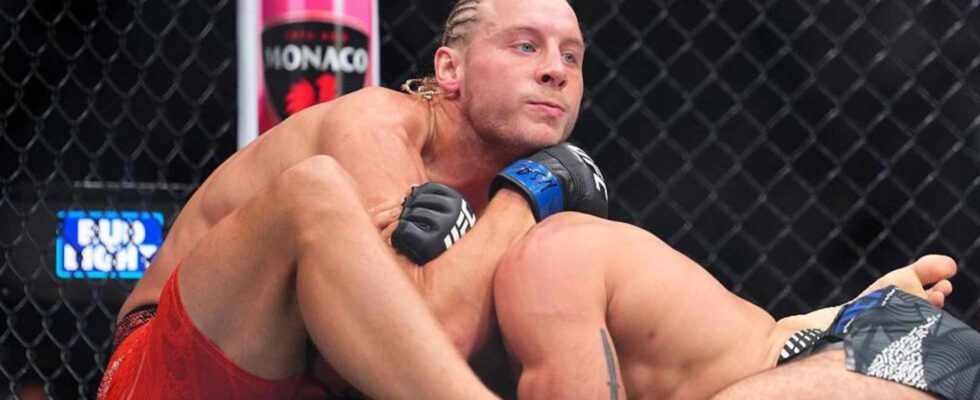
Paddy Pimblett closed out UFC 329 with a submission finish over Benoit Saint-Denis that left analysts and commentators searching for the right words to describe it. According to Pimblett himself, finding those words was harder than using the move because he had never done it before.
“No, my corner was right in front of me,” Pimblett said at the press conference after the bout. “My head coach Paul, Ellis and Chris were all there and Paul literally said don’t burn your arms out, but I knew I had it cinched up.”
The finish drew the attention of combat sports analysts almost immediately, including the Gracie brothers, who labeled the technique the “Peruvian D’ArceConda,” drawing from the three component chokes Pimblett blended in the moment: the D’Arce, the Peruvian necktie, and the Anaconda.
Each technique carries its own distinct strengths and its own well-established counters, but the combination created a sequence that Saint-Denis had no prepared answer for.
The sequence began with a D’Arce grip Pimblett had locked in tightly. When Saint-Denis proved too difficult to tip or roll by conventional means, Pimblett stood up, sat back, and threw his leg across his opponent’s back, borrowing the leg configuration central to the Peruvian necktie.
That repositioning collapsed the elbow Saint-Denis had been using to defend, exposing him to a type of compression the D’Arce alone cannot generate. When Saint-Denis attempted to roll out of the position, Pimblett followed him through the entire rotation, a level of commitment more characteristic of the Anaconda choke than anything else. When they landed, the lock was still on. Saint-Denis went limp, and Pimblett, aware his opponent was out, calmly looked to the referee.
For Pimblett, the preparation had been deliberate even if the specific sequence was not. He had spent the weeks leading into the bout preparing for Saint-Denis’s ability to defend the guillotine, and that preparation quietly laid the groundwork for what came next.
“I knew he was good at defending a guillotine, so we’d worked on other things around the guillotine, and that was just there, picture perfect,” he said.
“It wasn’t a proper Peruvian necktie, but I literally drilled a Peruvian necktie for the first time in about 10 years, about five weeks ago when we coached. It was like a mixture between a D’Arce and a Peruvian necktie, but that’s just how good my jiu-jitsu is. I can link things together like that flawlessly.”
What made the finish work was the way each technique contributed its most effective quality. The D’Arce provided the grip. The Peruvian necktie provided the leg placement and the pressure that dismantled Saint-Denis’s defense. The Anaconda provided the tenacity to follow an opponent through a full rotation without releasing the lock. Together, they formed a problem with no ready answer, largely because the combination had never existed as a recognized technique before that night.
When asked whether the risk of committing to a choke so early had crossed his mind, Pimblett was straightforward.
“Oh, I’ve never done that before. I haven’t, I’ve never done that before, I’ve just done that on the fly. That’s how I roll. My jiu-jitsu is the best in the world.”
