
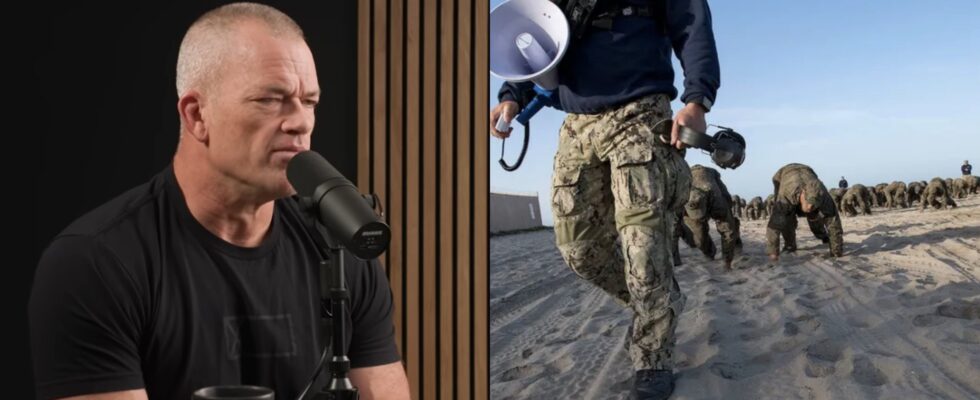
Former Navy SEAL commander Jocko Willink has witnessed a phenomenon that surprises many people: highly accomplished collegiate athletes often fail to complete SEAL training at higher rates than their less decorated peers. In a conversation with neuroscientist Andrew Huberman, Willink explained the psychological factor that separates those who persevere from those who ring the bell.
The selection process for Navy SEALs, known as BUD/S, maintains one of the highest attrition rates in military training. Division one wrestlers, football players, runners, and swimmers arrive with exceptional physical capabilities and competitive track records. Yet many of these standout athletes leave the program while others with less impressive credentials make it through.
According to Willink, the difference comes down to resilience in the face of repeated failure.
“The kid that was the star of the football team, the star of the basketball team, the captain of this, the captain of that, he’s been winning his whole life,” Willink said. “He goes to BUD/S and he quits. Because in BUD/S, you’re not gonna win. You’re certainly not going to win everything.”
The training deliberately identifies weaknesses in each candidate and exploits them. Instructors design scenarios where even the most capable athletes will experience repeated setbacks. For someone whose identity centers on winning, this creates a psychological crisis.
“They’re going to find what you’re not good at and they’re gonna exploit that and you’re going to lose,” Willink explained.
This pattern reveals something fundamental about human performance under pressure. Physical capability matters, but the mental framework for processing setbacks determines who continues forward.
Athletes who have dominated their sport may lack experience recovering from failure because they have rarely needed that skill. When confronted with an environment designed to produce losses, they lack the psychological tools to adapt.
Willink emphasized that this dynamic extends far beyond military training. In leadership roles, personal relationships, and professional settings, the ability to recover from setbacks without losing motivation separates those who build long careers from those who flame out after early success.
“A lot of guys that may lose and it disrupts their motivation, they’re probably just going to quit,” he said.
The answer, according to Willink, lies in taking action rather than dwelling on the loss. Whether facing a failed mission, a rejected job application, or a personal disappointment, forward movement provides the pathway out.
“Action for me is a cure for a lot of problems that we have in life,” he stated.
Rather than sitting with adversity, he advocates analyzing what went wrong, identifying concrete next steps, and performing them.
This approach applies equally to parents guiding children through disappointment and leaders managing teams after setbacks. The role of a leader, Willink suggests, involves serving as a counterweight to emotional extremes.
When a team celebrates success, the leader reminds them of areas to improve. When spirits drop after failure, the leader refocuses attention on lessons learned and next actions.
For elite athletes entering SEAL training, the challenge is not physical conditioning but mental recalibration.
