
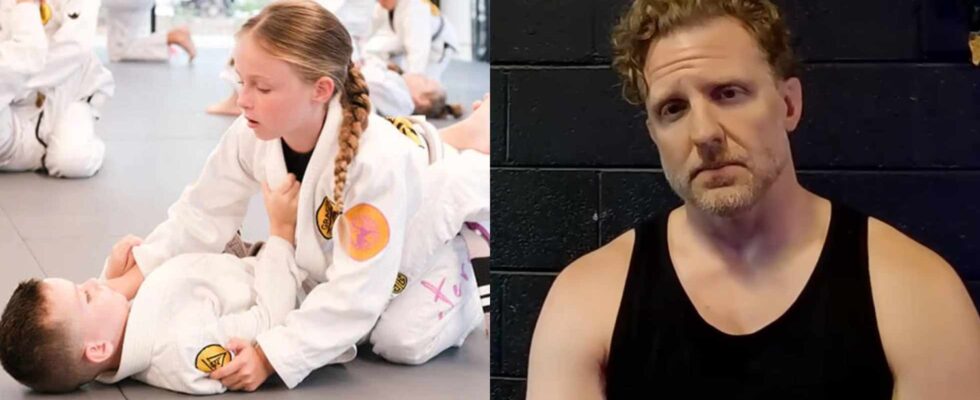
Greg Souders, founder and head coach of Standard Jiu-Jitsu and one of the most prominent voices in the constraint-led approach (CLA) to coaching, does not hold back when it comes to developing elite young athletes. On an episode of the Weslee Weighs In podcast, Souders made his position clear.
He stated, “To me, developing elite children is abuse.”
Souders grounds his statement in both research and years of direct coaching experience. He referenced a 40-year study on early childhood experiences and late-level elite performance in adulthood, which found that the majority of elite athletes studied played an average of roughly three sports before choosing their sport of choice around age 15 or 16.
“This seems to suggest that early childhood broad experiences prepare the student for later level specific experiences,” Souders explained. “And the elites usually choose their sport themselves around 15 to 16 years old. That’s what the evidence shows.”
For Souders, the core problem is parental projection.
He described the pattern as “a mistake that parents make because they can’t get over the failures that they had.”
Children pushed into elite training pathways by adults may display early high-level behavior, but that performance does not necessarily carry forward.
“It doesn’t necessarily mean that that early elite behavior that you’re calling elite is going to stick as they age,” he said, “because they’ll change once they hit puberty, and they’ll change once different things in life become more meaningful to them.”
The link between desire and skill sits at the center of his argument.
“You can only be as good as you desire to be,” Souders said. “If your desire is diminished and you’re forcing it, you’re never going to be as good.”
He added that he has never encountered a high-level performer who did not, at least to some degree, love what they were doing.
He pointed to Josh Waitzkin’s book “The Art of Learning” as a useful example. Waitzkin, a passionate young chess player, was hitting a point of deep frustration around age 11. His father responded with a firm rule: no chess in the summer. The family would go to the lake and let him simply be a kid.
“Even though at first it frustrated Josh, he came to appreciate it later in life,” Souders said, “because he realized how healthy the behavior was from his father.”
Souders acknowledged that his views carry a personal bias shaped by experience. He has had children in damaging training situations come through his gyms over the years, which is part of why he no longer teaches kids. He also recognized that parents navigating these decisions are working through something he, as someone without children, can only observe from the outside.
Still, his broader position holds firm.
“We have to look at the whole human. We have to look at the entirety of the experience from what happens in our childhood to what we’re looking to accomplish in our adulthood.”
