
2025 stands as one of the most turbulent years in Brazilian jiu-jitsu history. Life-threatening health emergencies, competitors passing away on the competition floor, promotional disputes and team expulsions forced the sport into uncomfortable conversations about safety, accountability and the cost of elite performance.
Ben Askren’s staph induced medical crisis
The community was shaken in late May when retired MMA star and former Olympic wrestler Ben Askren was hospitalized with a severe staph infection. What began as a small spot on his elbow, which he initially dismissed and treated himself, escalated rapidly. After training with Rafael Lovato Jr., Askren experienced what he believed was a routine back spasm. Within days, the infection entered his bloodstream and spread to his lungs, resulting in necrotizing pneumonia that destroyed lung tissue. His heart stopped four times during treatment and he spent more than seven weeks in a medically induced coma before ultimately requiring a double lung transplant.
Beyond the medical trauma, the financial burden became public. Despite having insurance, Askren faced coverage denials related to the transplant, a procedure that often costs between two and three million dollars. By September, Askren had regained consciousness and begun rehabilitation, weighing just 147 lbs (67 kg). Even then, he was already teaching private wrestling sessions from his garage, unable to fully step away from the sport.
Competitor Passes Away at IBJJF Chicago Summer Open
Only months later, tragedy struck again at the IBJJF Chicago Summer Open. Alvis E. Villarreal, a 50-year-old competitor, passed away after suffering a medical emergency shortly after completing his match and earning a bronze medal. Witnesses reported that Villarreal sat in the bleachers, his complexion changing dramatically, before collapsing. While the IBJJF stated that trained medical personnel responded immediately, multiple attendees questioned the speed and preparedness of the response.
The organization’s delayed public statement intensified frustration, offering condolences but little clarity on procedural changes. Villarreal’s family launched a GoFundMe that raised over $5,400 toward a $10,000 goal but the incident reignited debate over whether tournament safety standards have kept pace with the sport’s growth.
Craig Jones Invitational 2
Promotional controversy dominated much of the year as well. After the success of the first Craig Jones Invitational, expectations were high for the sequel.
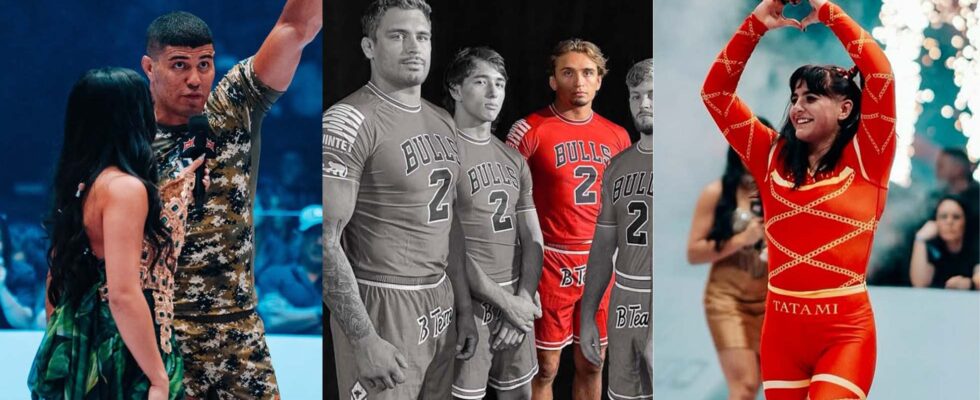
The situation escalated during the $1 million team tournament final between New Wave and B-Team. All five matches ended in double eliminations without submissions and judges’ scorecards resulted in a three-way tie at 47-47. B-Team was declared the winner based on a last match tiebreaker, citing Nick Rodriguez‘s 10-8 score in the final bout. Gordon Ryan accused the event of rule manipulation, arguing that the original agreement awarded victory to the team with more individual match wins, which would have favored New Wave.
Jones responded publicly alongside head judge Miha Perhavec, explaining that cumulative scoring determined the outcome and that the tiebreaker rule had been posted on the CJI website in advance. The dispute escalated further when an anonymous individual offered New Wave a separate $1 million payout, only to withdraw the offer days later. Jones’s response was blunt.
Offer rescinded. Ya lost. No prizes for second place.
Launch of UFC BJJ
UFC BJJ became the center of a different controversy. Throughout 2025, analysts and athletes questioned whether the promotion was artificially inflating view counts through paid promotion or bots. UFC BJJ 1 reportedly reached 750,000 views within 12 hours but engagement metrics showed that nearly 19 percent of comments matched known bot patterns. Jones compared these figures to legitimate UFC content featuring MMA stars like Sean O’Malley, noting that view counts and engagement did not align.
The pattern continued with UFC BJJ 2 and UFC BJJ 3. The latter, featuring Mikey Musumeci, jumped from 1.9 million views to 9 million in four days while gaining minimal additional comments or likes. Jones called the numbers statistically impossible to achieve.
As an athlete myself, I’m always looking for leverage in negotiations. We want to know what our true value is. If people were to inflate views or inflate comments, then it kind of does take a bit of the power away from the athlete.
Musumeci addressed the issue during an interview with Ariel Helwani.
So, at first I was just pumped. I saw 9 million views and I was like, Yeah, you know, I was just really happy. I don’t really understand or know how that works, like pumping views on YouTube. UFC has millions of subscribers but yeah, I really don’t know anything about this. That’s out of my pay grade.
The impact on athletes was visible. Social media growth for UFC BJJ competitors remained modest, despite appearing on a channel with over 20 million subscribers.
Jay Rod gets kicked out (and subsequently re-admitted) to B-Team
Accountability issues surfaced within gyms as well. In May, B-Team announced that ADCC silver medalist Jay Rodriguez had been banned after admitting to unhealthy interactions with women in the gym. Leadership discovered that Rodriguez had kept folders on his phone containing screenshots of female teammates’ Instagram profiles alongside adult content. Rodriguez later stated he was seeking therapy and denied rumors involving AI-generated images or hidden cameras. In December, reports surfaced that Rodriguez had returned to training at the rebranded Simple Man Martial Arts facility under limited conditions.
Izaak Michell Gets Kicked Out of Kingsway Due to SA allegeations
Soon after, Gordon Ryan and John Danaher confirmed that Izaak Michell was no longer affiliated with Kingsway Jiu-Jitsu. Hannah Griffith, an IBJJF No-Gi World Champion, publicly identified herself as one of Michell’s accusers and praised the swift response from gym leadership. Michell denied wrongdoing and claimed he was being targeted but the situation remained unresolved, raising questions about participation in future major events. Another women came forward with similar accusations. The police are said to be investigating his misconduct. He’s currently in Australia and it’s unclear if he will be back in the US.
Mackenzie Dern becomes a UFC Champion
Against this backdrop, Mackenzie Dern delivered one of the year’s defining competitive achievements by winning the UFC women’s strawweight title with a unanimous decision over Virna Jandiroba at UFC 321. The win placed Dern in rare company as one of the few athletes to hold world titles in IBJJF competition, ADCC, Abu Dhabi World Pro and the UFC.
It’s like a dream come true but every time I reach a goal I always make a new one.
Dishonerable mention: Derek Moneyberg
Moneyberg got his BJJ Black belt promotion in a controversial fashion. He proceeded to use the bad PR and to make his way through every show that would have him.
Gordon Ryan’s wife gets arrested for a felony charge
The year also saw the rivalry between Craig Jones and Gordon Ryan escalate beyond sport. When Ryan’s wife Nathalia Amato Santoro was arrested in Travis County on multiple charges including DWI and evading arrest, Jones posted her mugshot online and publicly sought bodycam footage. Ryan did not address the situation publicly, focusing instead on political commentary, which further fueled debate within the community.
Final Notes
You’ll see many websites asking you to vote in their rankings and polls. We won’t be one of them. Instead we’ve gathered a deeper look at Google trends in jiu-jitsu in 2026 to give you a better look at the events that left a mark.
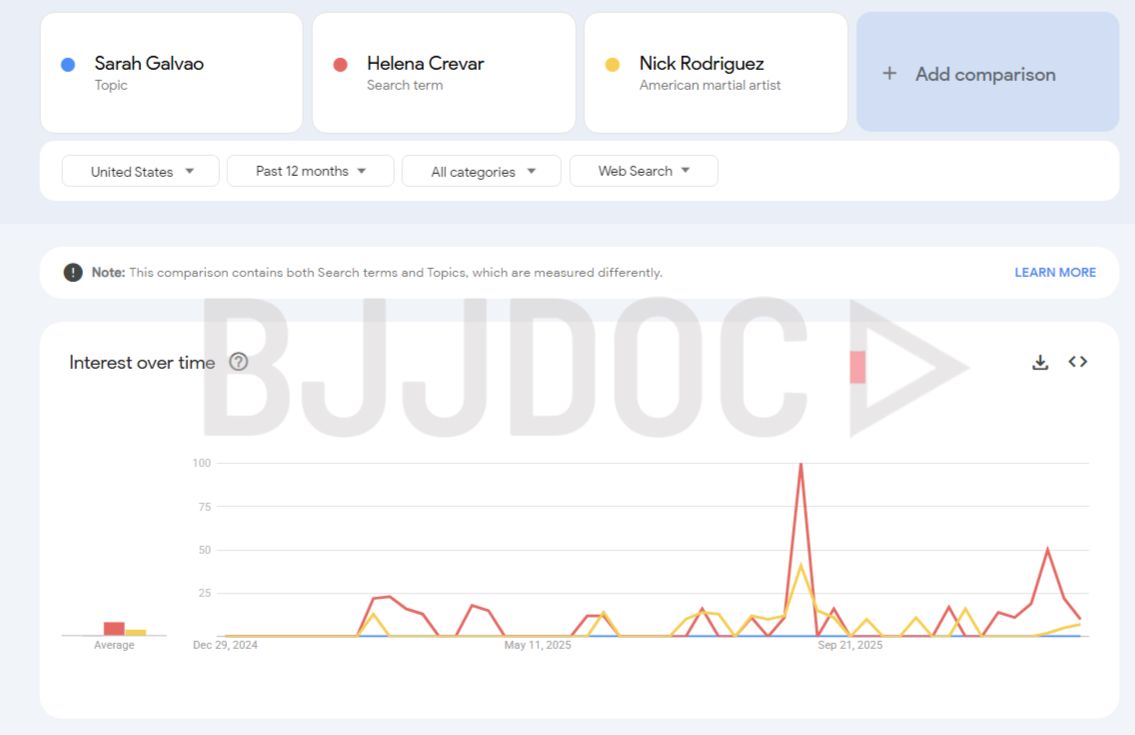
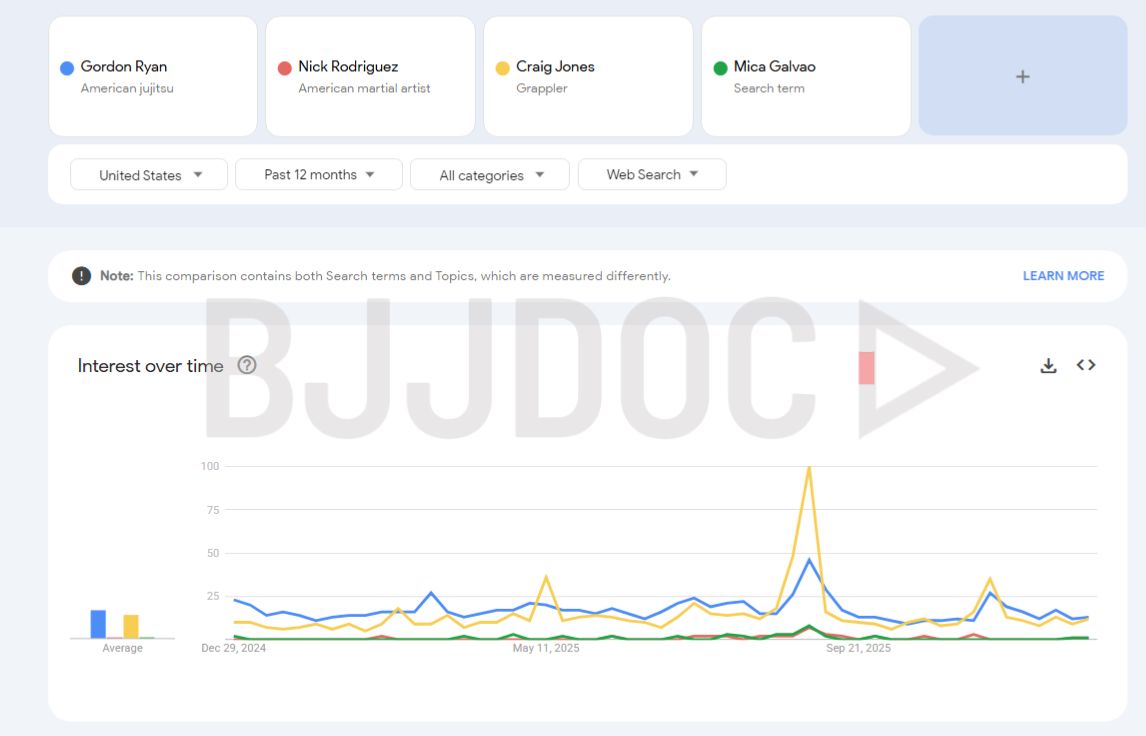
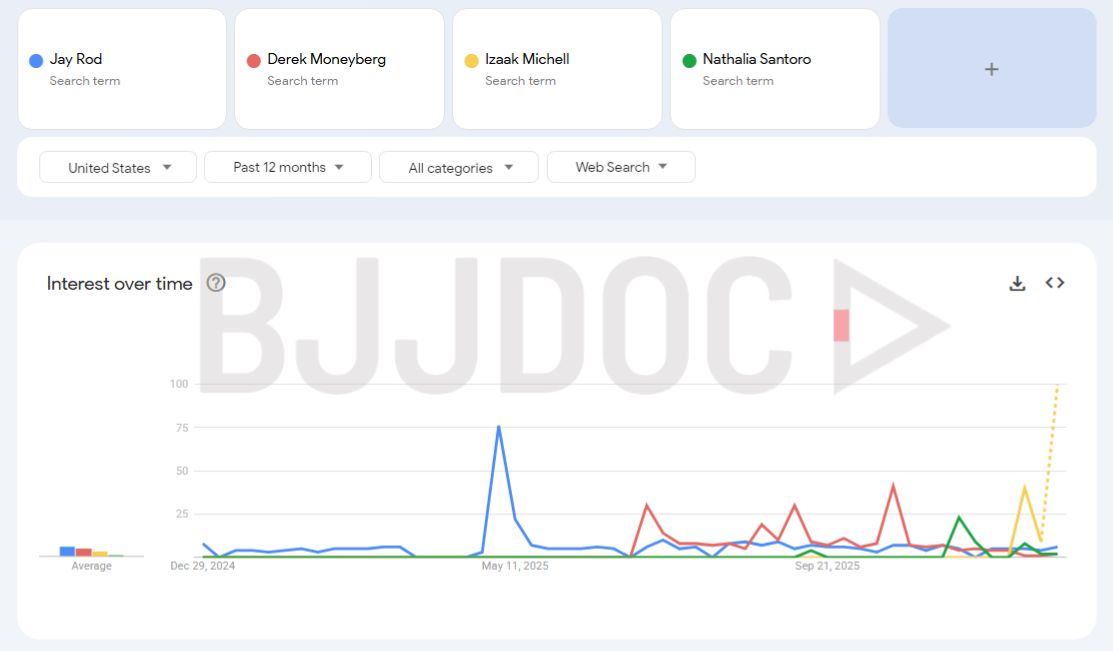
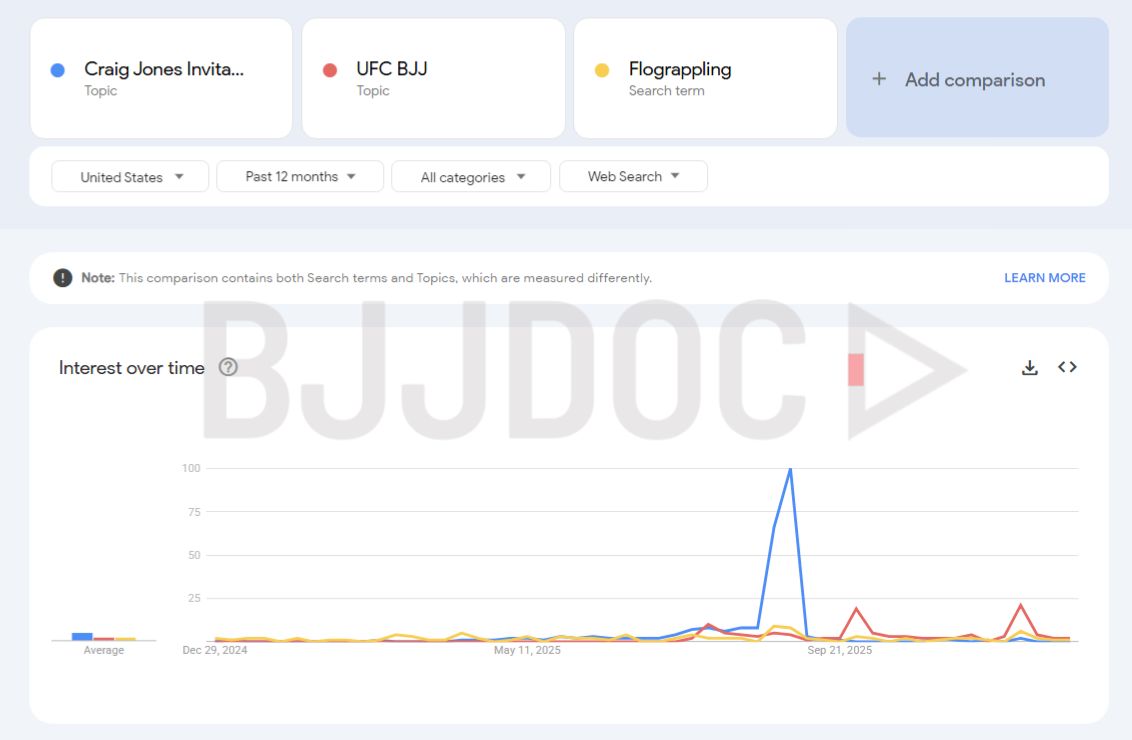
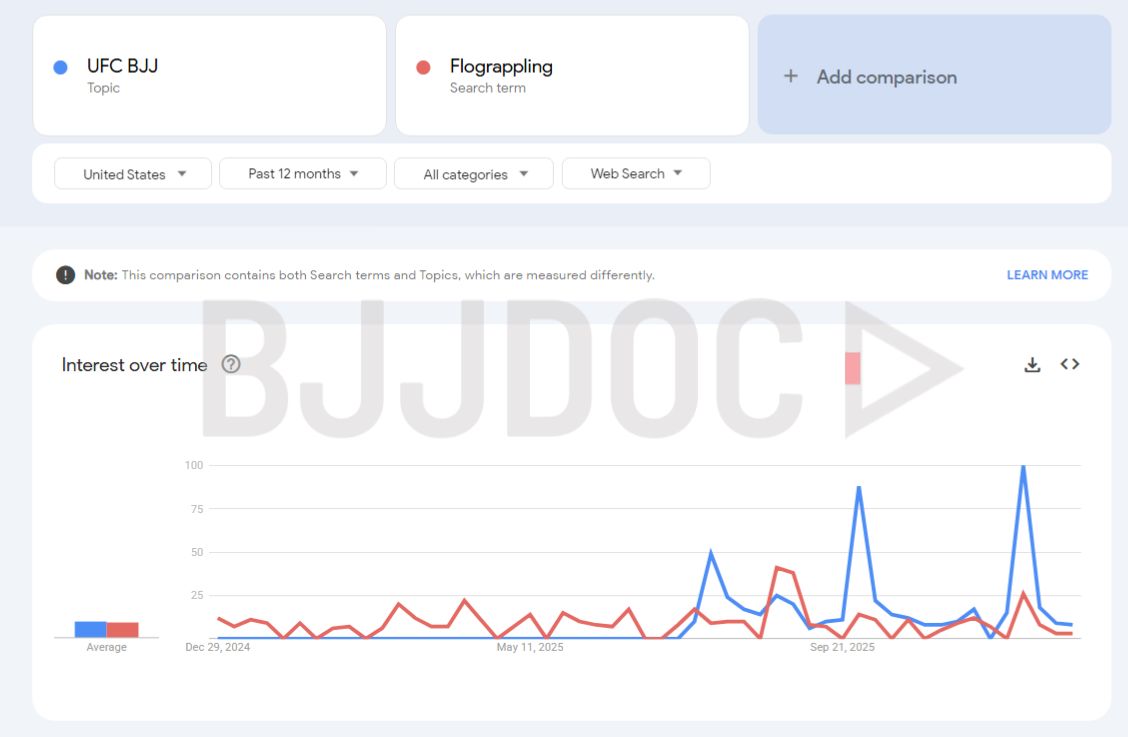
Taken together, 2025 exposed unresolved tensions in Brazilian jiu-jitsu. Rapid growth outpaced safety infrastructure. Misconduct cases forced gyms to confront how they balance talent and accountability. Promotional disputes revealed how easily metrics can be manipulated and how damaging that can be for athletes.
ONE FC declared Diogo Reis their Grappler of the year despite the fact that Reis was unable to capture any attention in the US. Arguably ONE FC’s biggest success is providing a vehicle for Tye Ruotolo.
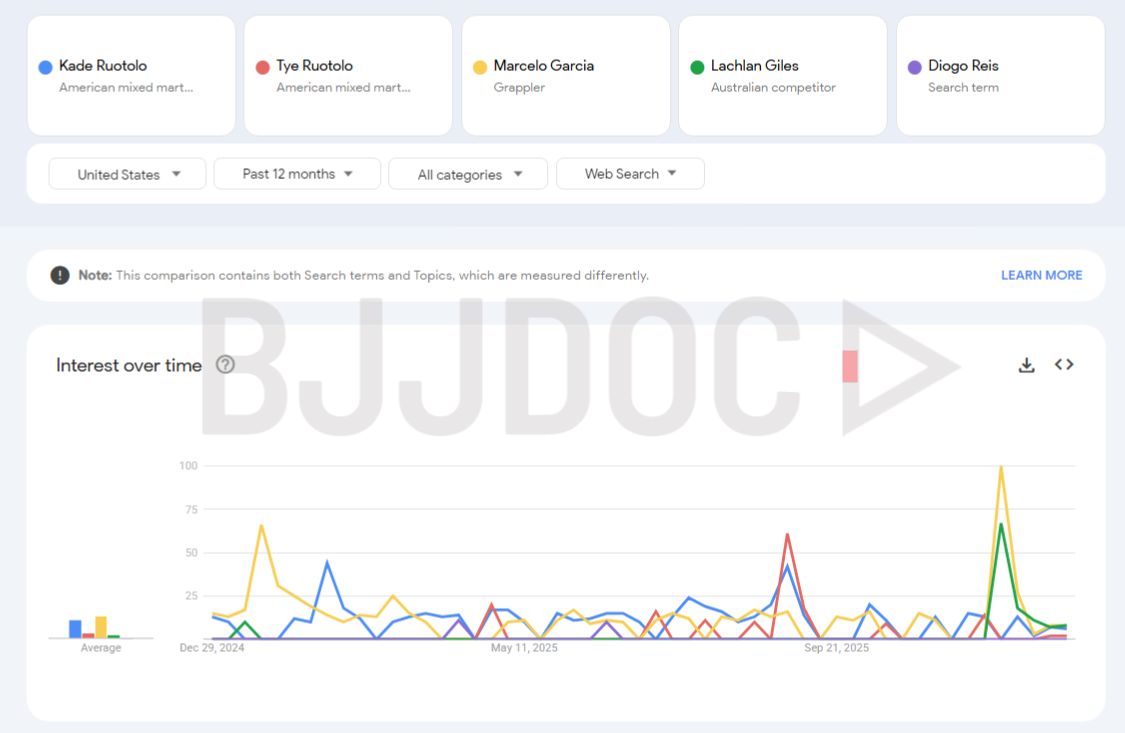
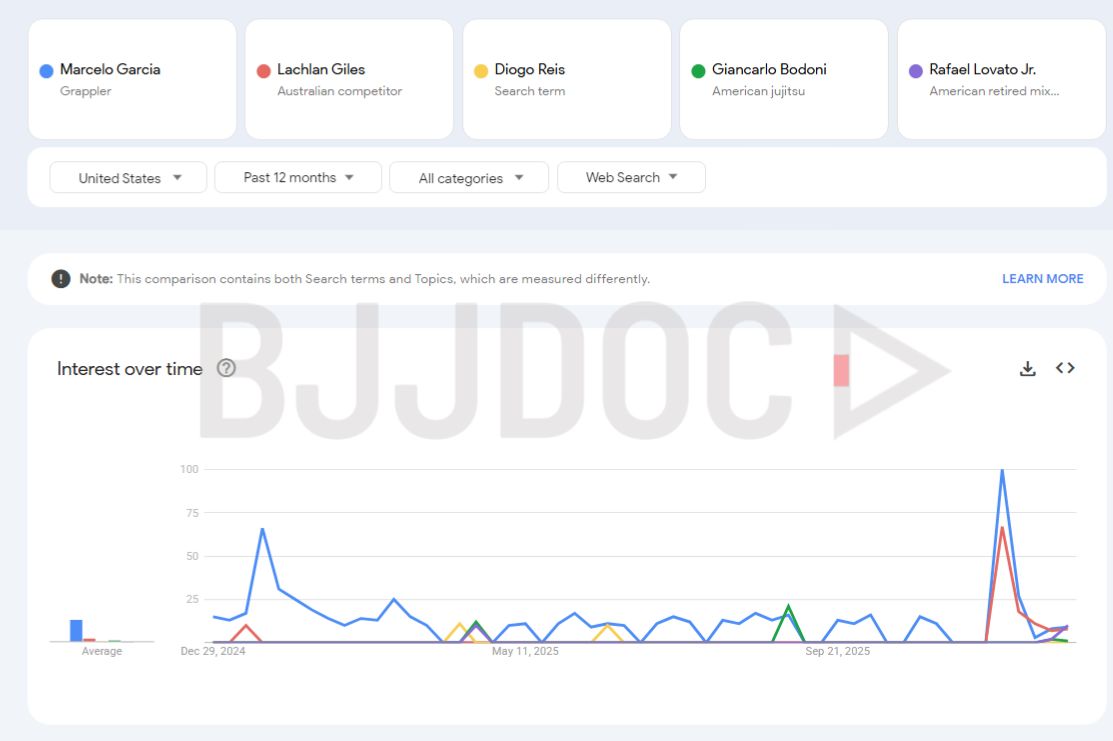
Yet the daily reality of the sport continued. Athletes trained. Coaches taught. Communities formed and endured. The stories of 2025 were not only about what went wrong but about how the community responded and what it chooses to change.
The mats have always carried risk. In 2025, that reality could no longer be ignored. How Brazilian jiu-jitsu responds to what was exposed will shape the sport far beyond the headlines.
